Hybrid Machine Learning Model for Efficient Botnet Attack Detection in Iot Environment.
Objective
The primary objective of this project is to develop and evaluate a hybrid machine learning model for effective botnet attack detection in IoT environments. By integrating Artificial Neural Networks (ANN), Convolutional Neural Networks (CNN), Long Short-Term Memory (LSTM) networks, and Recurrent Neural Networks (RNN) into a unified system, the project aims to enhance detection accuracy and robustness.
Abstract
The rapid advancement and widespread adoption of internet technologies have led to a surge in cyber attacks, with botnet attacks emerging as particularly detrimental. Identifying botnet activities is increasingly challenging due to the diverse attack vectors and the evolving nature of malware. As the Internet of Things (IoT) continues to expand, network devices become more vulnerable to these sophisticated attacks, resulting in significant security breaches and financial losses. To address this, we propose a hybrid machine learning model for effective botnet detection in IoT environments, leveraging a novel stacking approach that integrates Artificial Neural Networks (ANN), Convolutional Neural Networks (CNN), Long Short-Term Memory (LSTM) networks, and Recurrent Neural Networks (RNN) into a cohesive system referred to as ACLR. Our model is evaluated against individual models and demonstrates superior performance with a testing accuracy of 96.98%. Additionally, it achieves a K-fold cross-validation accuracy of 97.49% with optimal robustness and generalizability observed at k = 5. The ACLR model excels in detecting botnets, evidenced by a high Receiver Operating Characteristic Area Under the Curve (ROC-AUC) score of 0.9934 and a Precision-Recall Area Under the Curve (PR-AUC) score of 0.9950. Comparative analysis with existing state-of-the-art techniques highlights the effectiveness of the ACLR model in capturing the complex patterns of botnet activities, thereby offering a promising solution for enhancing cybersecurity measures in IoT environments.
Keywords: Botnet Detection,Hybrid Machine Learning,Artificial Neural Networks (ANN),Convolutional Neural Networks (CNN),Long Short-Term Memory (LSTM),Recurrent,Neural Networks (RNN),Internet of Things (IoT),Cybersecurity,Receiver,Operating Characteristic (ROC) Curve,Precision-Recall (PR) Curve
NOTE: Without the concern of our team, please don't submit to the college. This Abstract varies based on student requirements.
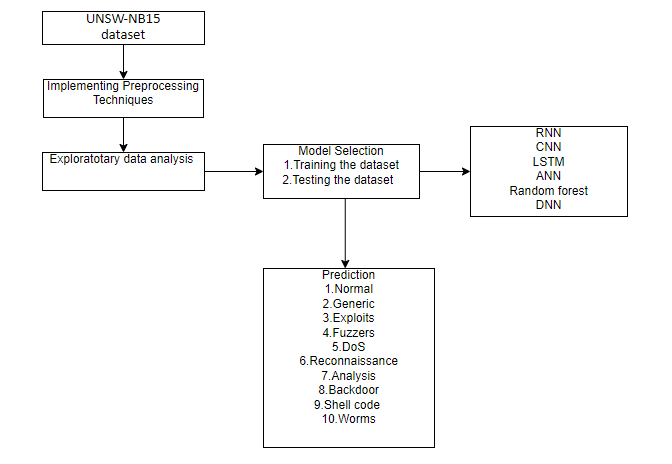
Block Diagram
Specifications
H/W CONFIGURATION:
Processor - I3/Intel Processor
Hard Disk - 160GB
Key Board - Standard Windows Keyboard
Mouse - Two or Three Button Mouse
Monitor - SVGA
RAM - 8GB
S/W CONFIGURATION:
• Operating System : Windows 7/8/10
• Server side Script : HTML, CSS, Bootstrap & JS
• Programming Language : Python,Machinelearning
• Libraries : Flask, Pandas, Mysql.connector, Os, Scikit-learn, Numpy
• IDE/Workbench : PyCharm
• Technology : Python 3.6+

Demo Video


Request for Video
 Paper Publishing
Request Call Back
Would you like to receive a free callback now?
Choose the best time for callback:
Leave your message and we will contact you as soon as possible

6-2-85/B, Old Maternity Hospital Road, Thyagaraja Nagar, Tirupati, Andhra Pradesh – 517501
+91 9030333433
+91 9393939065
0877-2261612

Disclaimer - Takeoff Edu Group Projects are not associated or affiliated with IEEE in any way. The IEEE Projects mentioned here are mentioned in the context of student projects, whose ideas are derived from IEEE publications, not projects of or by IEEE.

