HYBRID FULL ADDER CIRCUIT UTILIZING PASS TRANSISTOR AND PFAL ADIABATIC LOGIC STYLE
Objective
The primary goal is to reduce power consumption in digital circuits. This is achieved through the use of adiabatic logic, which allows for energy-efficient operation. • Adiabatic logic is designed to minimize power dissipation by gradually changing signal levels over time. • This approach helps reduce switching losses and overall power consumption.
Abstract
This paper introduces a groundbreaking hybrid full adder circuit that seamlessly integrates pass transistor logic (PTL) and pulse frequency adiabatic logic (PFAL). The innovative design aims to tackle the pressing challenges of power consumption and speed optimization in digital circuits while maintaining low voltage operation. By leveraging the strengths of both PTL and PFAL techniques, the proposed circuit achieves reduced power consumption through adiabatic switching and improved speed performance compared to traditional CMOS designs. Furthermore, the hybrid approach ensures compatibility with low-voltage applications, addressing a critical need in modern electronics. Through rigorous comparisons with conventional CMOS and PTL implementations, the authors demonstrate substantial improvements in terms of power efficiency and speed, particularly at lower supply voltages. This research contributes significantly to the field of energy-efficient digital circuit design, providing valuable insights into the potential benefits of combining different logic styles to achieve superior overall performance characteristics.
NOTE: Without the concern of our team, please don't submit to the college. This Abstract varies based on student requirements.
Block Diagram
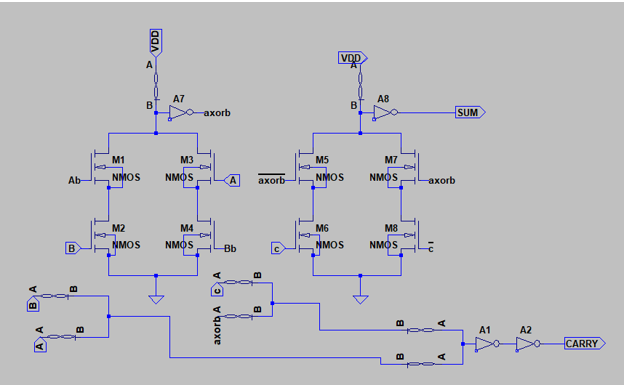
Specifications
Software Requirements:
· Tanner tool
· Technology files: 22nm
Hardware Requirements:
· Microsoft® Windows XP
· Intel® Pentium® 4 processor or Pentium 4 equivalent with SSE support
· 512 MB RAM
· 100 MB of available disk space
Learning Outcomes
- Introduction to Digital electronics
- Importance of Transistors
- MOS Fundamentals
- NMOS/PMOS/CMOS Technologies
- How to design circuits using Transistor logic?
- Scope of Adders in today’s world
- Applications in Real time.
- Tanner tool for design and simulation
- Solution providing for real time problems
- Project Development Skills:
- Problem Analysis Skills
- Problem Solving Skills
- Logical Skills
- Designing Skills
- Testing Skills
- Debugging Skills
- Presentation skills
- Thesis Writing Skills
Demo Video


Request for Video
Related Projects
 Paper Publishing
Request Call Back
Would you like to receive a free callback now?
Choose the best time for callback:
Leave your message and we will contact you as soon as possible

6-2-85/B, Old Maternity Hospital Road, Thyagaraja Nagar, Tirupati, Andhra Pradesh – 517501
+91 9030333433
+91 9393939065
0877-2261612

Disclaimer - Takeoff Edu Group Projects are not associated or affiliated with IEEE in any way. The IEEE Projects mentioned here are mentioned in the context of student projects, whose ideas are derived from IEEE publications, not projects of or by IEEE.

