Hybrid Compensation Based Efficient Wireless Charging System Design with Solar Photovoltaic Interface toward Sustainable Transportation
Also Available Domains DC - AC Converters|Electrical Vehicles
Objective
The main objective of this project is to design an efficient wireless charging system integrated with a solar photovoltaic interface to support sustainable transportation. The focus is on improving energy transfer efficiency and ensuring reliable power delivery to electric vehicles (EVs) using renewable energy sources.
Abstract
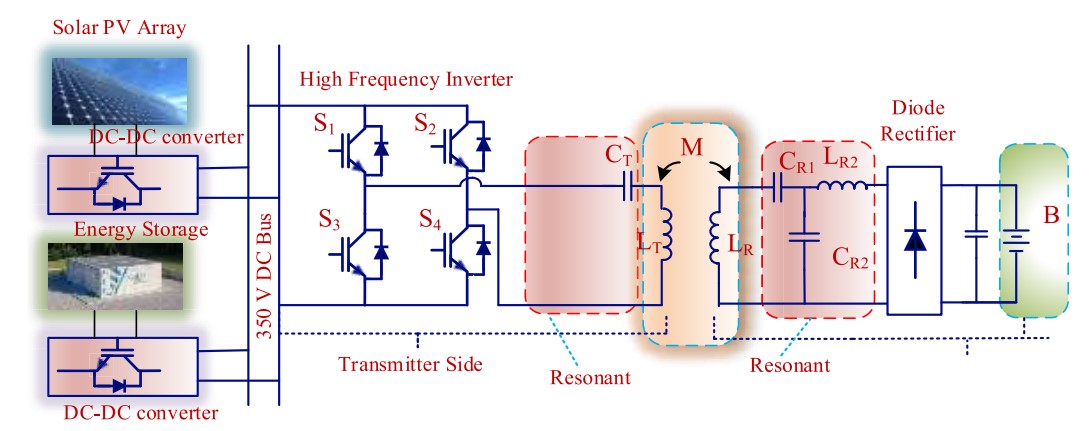
This paper presents the adoption of wireless charging for Electric Vehicles (EVs) is on the rise, promising enhanced user convenience. Concurrently, there is a pressing need for increased integration of renewable energy into the transportation sector. However, wireless charging systems face challenges such as power transfer fluctuations under load and variations in coupling coefficients. This research introduces a novel solution: a Photovoltaic (PV)-integrated hybrid-compensated wireless charging system tailored for EV applications. The study addresses critical hurdles in achieving optimal efficiency and power delivery while accommodating significant misalignments inherent in Wireless Power Transfer (WPT) systems, particularly beneficial for EV charging. Compared to conventional compensation WPT systems, the proposed hybrid compensation approach significantly enhances transfer efficiency and reduces system current stress. The paper proposes the utilization of S-LCC/SP-compensated constant current (CC) and constant voltage (CV) system for PV-integrated static WPT systems. Finally, simulation were conducted through Matlab-Simulink to verify the feasibility of the proposed method.
Keywords: Electric vehicle charging, photovoltaic integration, S-SP/LCC resonant network, wireless charging.
NOTE: Without the concern of our team, please don't submit to the college. This Abstract varies based on student requirements.
Block Diagram
Specifications
Software Configuration:
Operating System : Windows 7/8/10
Application Software: MATLAB / Simulink
Hardware Configuration:
RAM : 8 GB
Processor : I3 / I5 (Mostly prefer)
Learning Outcomes
· Introduction to Matlab/Simulink
· What is EISPACK & LINPACK
· How to start with MATLAB
· About Matlab language
· About tools & libraries
· Application of Matlab/Simulink
· About Matlab desktop
· Features of Matlab/Simulink
· Basics on MATLAB/Simulink
· Introduction to Solar
· Introduction to Boost converter
· Introduction to Bidirectional converter
· Introduction to the Inverter
· Introduction to the Rectifier
· Introduction to the Battery
· Introduction to the Charging stations
· Introduction to the wireless power transfer
· Introduction to Pulse Width Modulation (PWM),
· Project Development Skills:
o Problem analyzing skills
o Problem solving skills
o Creativity and imaginary skills
o Programming skills
o Deployment
o Testing skills
o Debugging skills
o Project presentation skills
o Thesis writing skills
Demo Video


Request for Video
 Paper Publishing
Request Call Back
Would you like to receive a free callback now?
Choose the best time for callback:
Leave your message and we will contact you as soon as possible

6-2-85/B, Old Maternity Hospital Road, Thyagaraja Nagar, Tirupati, Andhra Pradesh – 517501
+91 9030333433
+91 9393939065
0877-2261612

Disclaimer - Takeoff Edu Group Projects are not associated or affiliated with IEEE in any way. The IEEE Projects mentioned here are mentioned in the context of student projects, whose ideas are derived from IEEE publications, not projects of or by IEEE.

