Hybrid CNN and Transformer-Based Sequential Learning Techniques for Plant Disease Classification
Objective
This project focuses on classifying plant diseases using hybrid deep learning models that combine CNNs with sequential models like BiGRU, BiLSTM, and LSTM, enhanced with attention mechanisms and SE blocks. Four models—EfficientNet-BiGRU, ResNet50-BiLSTM, DenseNet121-CNN-LSTM, and MobileNetV3-LSTM—were trained on the PlantVillage dataset containing 34 disease classes. A web application was developed using Flask, allowing users to upload leaf images and receive classification results. The system aims to improve accuracy by learning both spatial and contextual features, offering an efficient solution for multi-class image classification tasks.
Abstract
This project focuses on developing an image classification system for identifying plant diseases using deep learning. The system integrates Convolutional Neural Networks (CNNs) with sequential learning models such as BiGRU, BiLSTM, and LSTM. Attention mechanisms and Squeeze-and-Excitation (SE) modules are incorporated to enhance feature learning. Four hybrid models are implemented: EfficientNet with BiGRU and Attention, ResNet50 with BiLSTM and Attention, DenseNet121 with CNN-LSTM, and MobileNetV3 with LSTM and SE Attention. The PlantVillage dataset, which includes 34 distinct plant disease categories, is used for training and evaluation. The system is deployed as a web application built using Flask, with a simple user interface for image upload and classification result display. The combination of advanced CNNs and sequential learning enables improved accuracy and contextual understanding of image features. The project aims to explore the effectiveness of hybrid deep learning techniques in the classification task and provide a working prototype through a functional web interface.
Keywords: CNN, BiGRU, BiLSTM, LSTM, Attention, SE block, EfficientNet, ResNet50, DenseNet121, PlantVillage
NOTE: Without the concern of our team, please don't submit to the college. This Abstract varies based on student requirements.
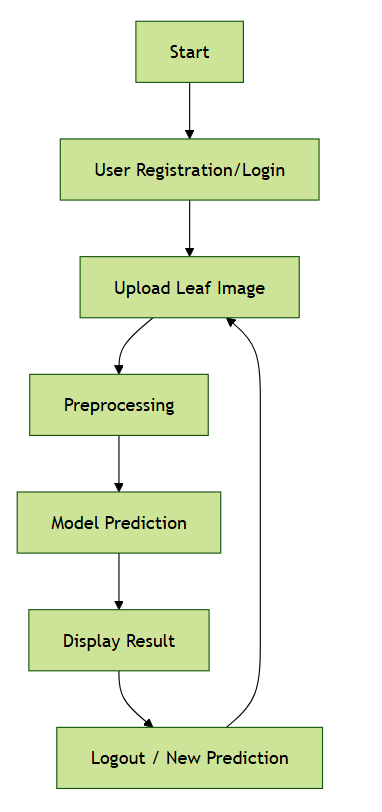
Block Diagram
Specifications
H/W CONFIGURATION:
Processor - I3/Intel Processor
Hard Disk - 160GB
Key Board - Standard Windows Keyboard
Mouse - Two or Three Button Mouse
Monitor - SVGA
RAM - 8GB
S/W CONFIGURATION:
• Operating System : Windows 7/8/10
• Server side Script : HTML, CSS, Bootstrap & JS
• Programming Language : Python
• Libraries : Flask, Pandas, MySQL. Connector, Scikit-Learn
• IDE/Workbench : VS Code
• Technology : Python 3.8+
• Server Deployment : Xampp Server

Demo Video


Request for Video
 Paper Publishing
Request Call Back
Would you like to receive a free callback now?
Choose the best time for callback:
Leave your message and we will contact you as soon as possible

6-2-85/B, Old Maternity Hospital Road, Thyagaraja Nagar, Tirupati, Andhra Pradesh – 517501
+91 9030333433
+91 9393939065
0877-2261612

Disclaimer - Takeoff Edu Group Projects are not associated or affiliated with IEEE in any way. The IEEE Projects mentioned here are mentioned in the context of student projects, whose ideas are derived from IEEE publications, not projects of or by IEEE.

