Human-Centered AI in Smart Farming: Toward Agriculture 5.0
Objective
This study explores the role of human-centered AI in smart farming, aiming to drive the transition to Agriculture 5.0 by enhancing efficiency, sustainability, and decision-making in agricultural practices
Abstract
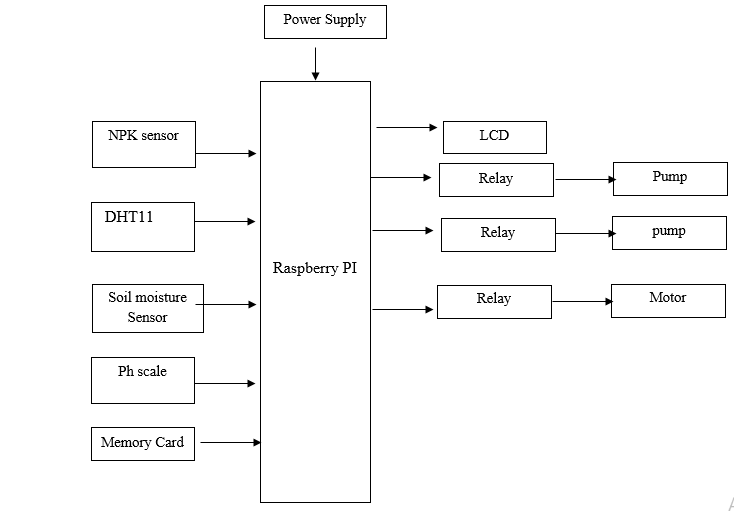
This project explores the integration of Human-Centered AI in smart farming through the development of an intelligent agricultural system aimed at enhancing the efficiency of crop management in Agriculture 5.0. Utilizing a combination of NPK sensor, soil moisture sensor, pH scale, DHT11 sensor, and Raspberry Pi, the system continuously monitors essential soil parameters. A Random Forest algorithm processes the sensor data to automate the irrigation and fertilization process. Specifically, when NPK levels are detected to be low, an NPK motor is activated; if the pH level falls outside the optimal range, a pump is triggered to adjust the pH; and if soil moisture levels are inadequate, the irrigation system is automatically turned on. The system’s real-time status is displayed on an LCD, ensuring farmers are always informed. This approach aims to improve decision-making in farming, optimize resource use, and promote sustainable agricultural practices in the context of smart farming technologies.
NOTE: Without the concern of our team, please don't submit to the college. This Abstract varies based on student requirements.
Block Diagram
Specifications
Hardware requirements:
- - Raspberry Pi
- -NPK Sensor
- - DHT11 Sensor
- - Soil Moisture Sensor
- - Relay
- - Pump
- - Motor
- - Ph scale
- - Memory Card
Software requirements:
- Raspian os
- Python IDLE
Learning Outcomes
- - Understanding the architecture and pin configuration of Raspberry Pi and Arduino
- - Installing and configuring Arduino IDE and Raspberry Pi setup
- - Interfacing voltage, current, vibration, and temperature sensors with Raspberry Pi and Arduino
- - Implementing real-time data acquisition and monitoring
- - Introduction to Random Forest algorithms for fault detection
- - Working with Npk Sensor ,Soil moisture sensor for sensor data
- - Understanding power supply requirements for Raspberry Pi
- About Project Development Life Cycle:
- Planning and Requirement Gathering (software’s, Tools, Hardware components, etc.,)
- Schematic preparation
- Code development and debugging
- Hardware development and debugging
- Development of the Project and Output testing
- Practical exposure to:
- Hardware and software tools.
- Solution providing for real time problems.
- Working with team/ individual.
- Work on Creative ideas.
- Project development Skills
- Problem analyzing skills
- Problem solving skills
- Creativity and imaginary skills
- Programming skills
- Deployment
- Testing skills
- Debugging skills
- Project presentation skills
- Thesis writing skills


 Paper Publishing

Request Call Back
Would you like to receive a free callback now?
Choose the best time for callback:
Leave your message and we will contact you as soon as possible

6-2-85/B, Old Maternity Hospital Road, Thyagaraja Nagar, Tirupati, Andhra Pradesh – 517501
+91 9030333433
+91 9393939065
0877-2261612

Disclaimer - Takeoff Edu Group Projects are not associated or affiliated with IEEE in any way. The IEEE Projects mentioned here are mentioned in the context of student projects, whose ideas are derived from IEEE publications, not projects of or by IEEE.

