High Speed Gate Level Synchronous Full Adder Designs
Objective
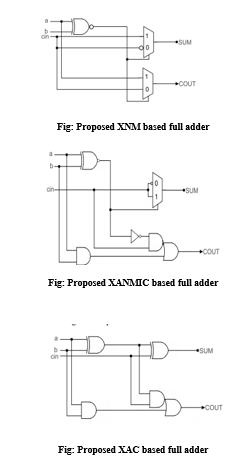
This article primarily focuses on the novel design of full adders at the logic level and also highlights a comparison with many other existing gate level solutions, from performance and area perspectives.
Abstract
The foundational role of addition in digital computer systems is highlighted in this study, which introduces three innovative gate-level full adder designs. These designs are developed using components from a standard cell library: the first design employs XNOR and multiplexer gates (XNM), the second integrates XNOR, AND, Inverter, multiplexer, and complex gates (XNAIMC), and the third utilizes XOR, AND, and complex gates (XAC). These designs are compared with numerous existing gate-level full adder implementations. Through comprehensive simulations with a 32-bit carry-ripple adder implementation, targeting three process, voltage, and temperature (PVT) corners of the high-speed (low Vt) 65nm STMicroelectronics CMOS process, it was determined that the XAC-based full adder exhibits superior delay efficiency compared to all other gate-level counterparts, including the full adder cell from the library. The XNM-based full adder was identified as area-efficient, whereas the XNAIMC-based full adder showed a moderate balance between speed and area efficiency compared to the other two designs. The circuit has been successfully designed and implemented using Tanner EDA tool at 45nm technology.
Keywords—Combinational logic, Full adder, High performance, Standard cells, and Deep submicron design.
NOTE: Without the concern of our team, please don't submit to the college. This Abstract varies based on student requirements.
Block Diagram
Specifications
Software Requirements:
· Tool: Tanner EDA
· Technology files: PTM 45nm
Hardware Requirements:
· Microsoft® Windows XP
· Intel® Pentium® 4 processor or Pentium 4 equivalent with SSE support
· 512 MB RAM
· 100 MB of available disk space
Learning Outcomes
- Introduction to Digital electronics
- Importance of Transistors
- MOS Fundamentals
- NMOS/PMOS/CMOS Technologies
- How to design circuits using Transistor logic?
- Scope of ADDER in today’s world
- Applications in Real time.
- ADDER importance.
- Solution providing for real time problems
- Project Development Skills:
- Problem Analysis Skills
- Problem Solving Skills
- Logical Skills
- Designing Skills
- Testing Skills
- Debugging Skills
- Presentation skills
- Thesis Writing Skills


 Paper Publishing

Request Call Back
Would you like to receive a free callback now?
Choose the best time for callback:
Leave your message and we will contact you as soon as possible

6-2-85/B, Old Maternity Hospital Road, Thyagaraja Nagar, Tirupati, Andhra Pradesh – 517501
+91 9030333433
+91 9393939065
0877-2261612

Disclaimer - Takeoff Edu Group Projects are not associated or affiliated with IEEE in any way. The IEEE Projects mentioned here are mentioned in the context of student projects, whose ideas are derived from IEEE publications, not projects of or by IEEE.

