High-Speed Energy-Efficient Fixed-Point Signed Multipliers for FPGA-Based DSP Applications
Objective
The project is to design and optimize fixed-point signed multipliers for use in digital signal processing (DSP) on FPGA platforms. The focus will be on achieving high-speed operation while minimizing energy consumption.
Abstract
Digital Signal Processing (DSP) applications such as image processing, wireless communication, and real-time data analytics require high-performance arithmetic units that can operate efficiently within strict energy constraints. Multipliers, being one of the most critical components, directly impact the speed, power consumption, and area utilization of FPGA-based systems. Conventional signed multipliers often suffer from trade-offs between high speed and energy efficiency, limiting their suitability for low-power, high-throughput applications. This work presents the design and analysis of high-speed, energy-efficient fixed-point signed multipliers optimized for FPGA implementation. The proposed architecture leverages efficient partial product reduction techniques and parallel processing strategies to minimize critical path delay while reducing dynamic power dissipation. Comparative analysis with conventional multiplier designs highlights significant improvements in throughput, energy-per-operation, and resource utilization. The results demonstrate that the proposed multipliers not only achieve faster computation speeds but also provide enhanced energy efficiency, making them highly suitable for next-generation DSP applications in portable and real-time embedded systems.
NOTE: Without the concern of our team, please don't submit to the college. This Abstract varies based on student requirements.
Block Diagram
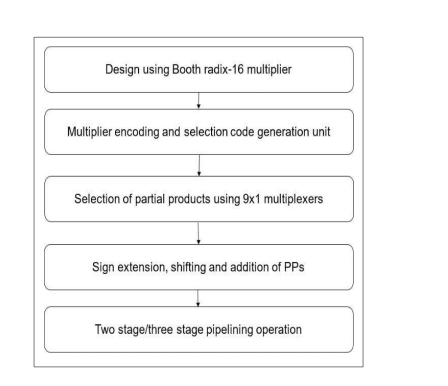
Specifications
Specifications:
Software Requirements:
VIVADO 2018.3
Hardware Requirements:
Learning Outcomes
-
Understand the role of multipliers in FPGA-based Digital Signal Processing (DSP) systems and their impact on overall system performance.
-
Analyze the challenges of designing high-speed and low-power fixed-point signed multipliers for real-time applications.
-
Gain knowledge of advanced multiplier architectures, including partial product reduction and parallel processing techniques.
-
Develop skills in FPGA-based design, implementation, and simulation of fixed-point arithmetic circuits.
-
Evaluate the performance of multiplier designs in terms of speed, energy efficiency, resource utilization, and throughput.
-
Compare proposed multiplier architectures with conventional designs to highlight trade-offs between power, area, and delay.
-
Strengthen the ability to optimize digital arithmetic circuits for energy-constrained DSP applications.
-
Apply hardware description languages (HDLs) and FPGA tools to verify functionality and performance of multiplier circuits.
-
Demonstrate the significance of energy-efficient high-speed multipliers in practical domains such as image processing, wireless communication, and embedded systems.
-
Enhance problem-solving and research skills by addressing real-world constraints in low-power, high-performance digital circuit design.


 Paper Publishing

Request Call Back
Would you like to receive a free callback now?
Choose the best time for callback:
Leave your message and we will contact you as soon as possible

6-2-85/B, Old Maternity Hospital Road, Thyagaraja Nagar, Tirupati, Andhra Pradesh – 517501
+91 9030333433
+91 9393939065
0877-2261612

Disclaimer - Takeoff Edu Group Projects are not associated or affiliated with IEEE in any way. The IEEE Projects mentioned here are mentioned in the context of student projects, whose ideas are derived from IEEE publications, not projects of or by IEEE.

