High Performance VLSI Architecture of FIR Filter for Seismic Signal Processing
Objective
In this paper, we present a new LO and LD minimization matrix grouped CSE algorithm that outperforms existing CSE algorithms.
Abstract
Seismic signal processing plays a crucial role in geophysical exploration, earthquake monitoring, and various other scientific and industrial applications. Finite Impulse Response (FIR) filters are essential components in seismic data analysis, providing critical filtering functions to enhance signal quality and extract relevant information. This paper presents a high-performance Very Large Scale Integration (VLSI) architecture for FIR filters tailored specifically for seismic signal processing.
The proposed VLSI architecture focuses on optimizing both hardware efficiency and processing speed, aiming to meet the demanding requirements of real-time seismic data analysis. To achieve this goal, we employ novel design techniques, including parallelism, pipelining, and optimized coefficient storage, to enhance the overall performance of the FIR filter. The architecture leverages state-of-the-art semiconductor technology to ensure efficient hardware utilization while minimizing power consumption.
NOTE: Without the concern of our team, please don't submit to the college. This Abstract varies based on student requirements.
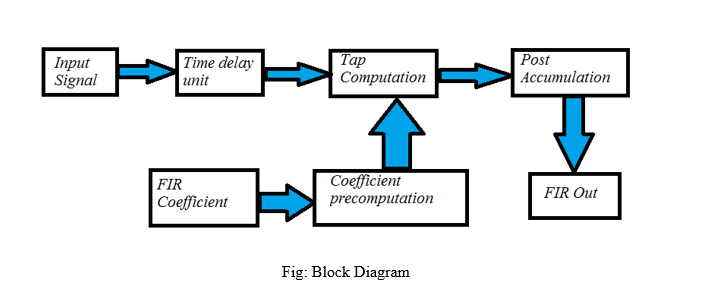
Block Diagram
Specifications
Software Requirements:
· Tool: Xilinx Vivado
· HDL: Verilog
Learning Outcomes
· Introduction to digital & analog electronics
· Understanding of VLSI Concepts
· Understanding of FIR Filters
o Optimization Strategies
· Knowledge on Seismic Signal Processing
o Application in Geophysics
· Knowledge on Verilog
· Simulation & Verification
· Testing & Debugging skills
· Real world Applications


 Paper Publishing

Request Call Back
Would you like to receive a free callback now?
Choose the best time for callback:
Leave your message and we will contact you as soon as possible

6-2-85/B, Old Maternity Hospital Road, Thyagaraja Nagar, Tirupati, Andhra Pradesh – 517501
+91 9030333433
+91 9393939065
0877-2261612

Disclaimer - Takeoff Edu Group Projects are not associated or affiliated with IEEE in any way. The IEEE Projects mentioned here are mentioned in the context of student projects, whose ideas are derived from IEEE publications, not projects of or by IEEE.

