Heart Disease Prediction Using a Hybrid Feature Selection and Ensemble Learning Approach
Objective
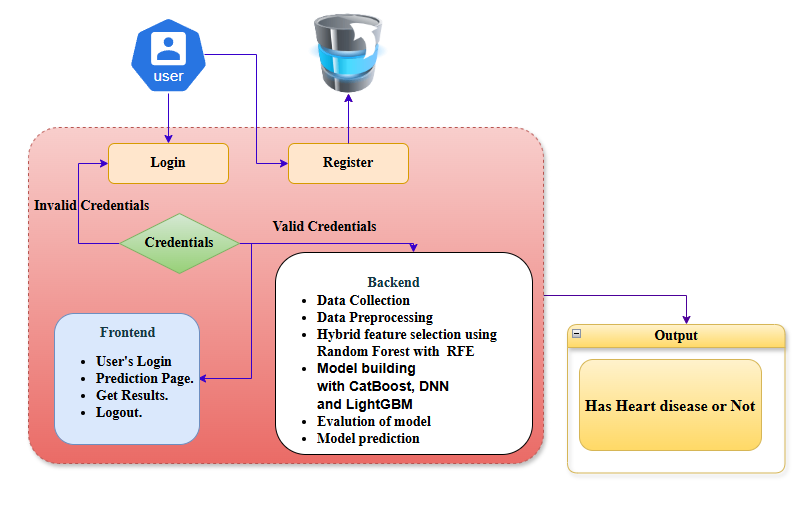
The main objective of this research is to design and develop a robust predictive framework for heart disease classification by integrating hybrid feature selection and ensemble learning techniques. The study aims to preprocess the dataset effectively through normalization, encoding, and handling of missing values to ensure data consistency and model reliability. A hybrid feature selection process combining Random Forest and Recursive Feature Elimination (RFE) is implemented to identify the most influential clinical parameters while eliminating redundant and noisy features. The refined dataset is used to train multiple classifiers such as CatBoost, LightGBM, and Deep Neural Networks (DNN) to evaluate individual model performance. To further enhance prediction accuracy and stability, an ensemble model integrating CatBoost, DNN, and AdaBoost is developed, where the ensemble weights are optimized using a Genetic Algorithm. The objective is to achieve high accuracy, precision, recall, and F1-score while maintaining interpretability and computational efficiency. This research ultimately seeks to establish an adaptive and scalable classification model capable of improving diagnostic reliability and decision-making within structured medical datasets.
Abstract
Heart disease prediction requires
analyzing diverse clinical attributes with complex interdependencies. This
research presents a hybrid framework that combines optimized feature selection
with advanced ensemble learning to improve prediction accuracy and
interpretability. The dataset includes parameters such as age, sex, chest pain
type, blood pressure, cholesterol, fasting blood sugar, electrocardiographic
results, maximum heart rate, exercise-induced angina, and thalassemia
condition.
Keywords: Heart disease, Feature Selection, Random Forest, Recursive Feature Elimination, CatBoost, LightGBM, Deep Neural Network, AdaBoost, Genetic Algorithm, Ensemble Learning.
NOTE: Without the concern of our team, please don't submit to the college. This Abstract varies based on student requirements.
Block Diagram
Specifications
HARDWARE REQUIREMENTS
• Processor - I5/Intel Processor
• RAM - 8GB (min)
• Hard Disk - 160 GB
• Key Board - Standard Windows Keyboard
• Mouse - Two or Three Button Mouse
• Monitor - Any
SOFTWARE REQUIREMENS
• Operating System : Windows 7/8/10
• Server side Script : HTML, CSS, Bootstrap & JS
• Programming Language : Python
• Libraries : Flask, Pandas, Mysql.connector, Os, Numpy,
Scikit-learn.
• IDE/Workbench : VS-Code
• Technology : Python 3.10+
• Server Deployment : Xampp Server
• Database : MySQL

Demo Video


Request for Video
 Paper Publishing
Request Call Back
Would you like to receive a free callback now?
Choose the best time for callback:
Leave your message and we will contact you as soon as possible

6-2-85/B, Old Maternity Hospital Road, Thyagaraja Nagar, Tirupati, Andhra Pradesh – 517501
+91 9030333433
+91 9393939065
0877-2261612

Disclaimer - Takeoff Edu Group Projects are not associated or affiliated with IEEE in any way. The IEEE Projects mentioned here are mentioned in the context of student projects, whose ideas are derived from IEEE publications, not projects of or by IEEE.

