Heart disease prediction QUANTUM COMPUTING
Objective
The primary objective of this project is to develop an accurate heart disease prediction model using Variational Quantum Classifier (VQC) and Quantum Support Vector Machine (QSVM) algorithms, leveraging quantum computing techniques for enhanced performance.
Abstract
Heart disease prediction has become an important area of research in the field of healthcare due to its global health impact. Early detection of heart disease can significantly reduce mortality rates and improve patient outcomes. This study utilizes a publicly available heart disease dataset with 14 attributes, including age, sex, chest pain type, resting blood pressure, serum cholesterol, and other clinical measurements, to predict the presence of heart disease. The dataset contains 76 records, where the target variable indicates the presence or absence of heart disease (0 = no disease, 1 = disease). This work proposes the application of advanced machine learning techniques, specifically the Variational Quantum Classifier (VQC) and Quantum Support Vector Machine (QSVM), to predict heart disease. The VQC leverages the power of quantum computing for classification tasks, while QSVM applies quantum principles to support vector machines, offering enhanced accuracy and performance. These quantum-based algorithms are expected to provide a promising alternative to traditional machine learning models, especially in terms of handling complex, high-dimensional datasets with enhanced computational efficiency. By comparing the performance of VQC and QSVM with classical machine learning methods, this research aims to demonstrate the potential of quantum algorithms in medical predictions, particularly in the early detection of heart disease, thereby contributing to more effective healthcare management.
Keywords
Heart disease prediction, quantum computing, Variational Quantum Classifier (VQC), Quantum Support Vector Machine (QSVM), machine learning, healthcare management, early detection, high-dimensional datasets, computational efficiency, medical predictions.
NOTE: Without the concern of our team, please don't submit to the college. This Abstract varies based on student requirements.
Block Diagram
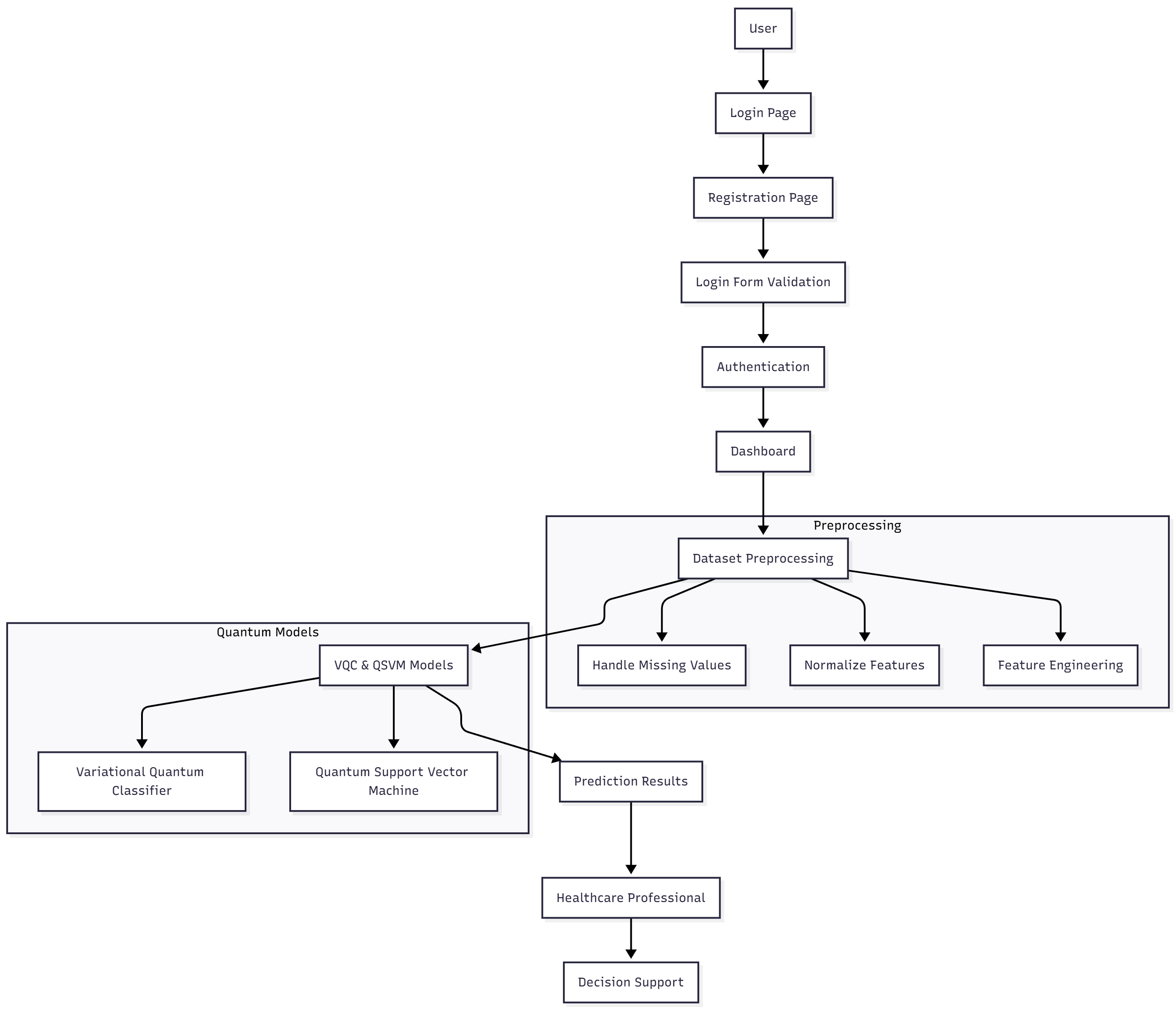
Specifications
H/W CONFIGURATION:
Processor - I3/Intel Processor
Hard Disk - 160GB
Key Board - Standard Windows Keyboard
Mouse - Two or Three Button Mouse
Monitor - SVGA
RAM - 8GB
S/W CONFIGURATION:
• Operating System : Windows 7/8/10
• Server side Script : HTML, CSS, Bootstrap & JS
• Programming Language : Python
• Libraries : Flask, Pandas, Mysql.connector, Os, Scikit-learn, Numpy
• IDE/Workbench : PyCharm
• Technology : Python 3.6+
• Server Deployment : Xampp Server

Demo Video


Request for Video
 Paper Publishing
Request Call Back
Would you like to receive a free callback now?
Choose the best time for callback:
Leave your message and we will contact you as soon as possible

6-2-85/B, Old Maternity Hospital Road, Thyagaraja Nagar, Tirupati, Andhra Pradesh – 517501
+91 9030333433
+91 9393939065
0877-2261612

Disclaimer - Takeoff Edu Group Projects are not associated or affiliated with IEEE in any way. The IEEE Projects mentioned here are mentioned in the context of student projects, whose ideas are derived from IEEE publications, not projects of or by IEEE.

