Hardware-Software Data Acquisition System for Measuring the Grip Strength in Children
Objective
To build a hardware-software system for measuring grip strength in children. The system aims to provide accurate data collection for health and rehabilitation assessments.
Abstract
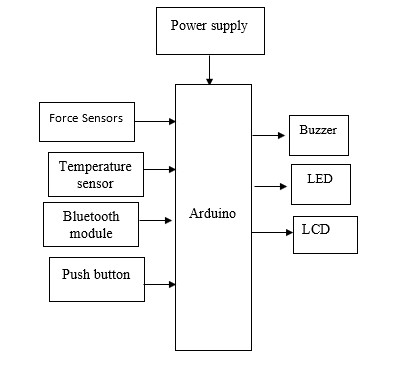
Hand grip strength is an important indicator of muscular development, physical fitness, and overall health in children. Accurate measurement of grip strength plays a vital role in pediatric healthcare, physiotherapy, rehabilitation, and clinical assessment. Conventional grip strength measurement devices are often expensive, bulky, and lack digital data acquisition and wireless communication capabilities. This project presents a Hardware–Software Data Acquisition System for Measuring the Grip Strength in Children, a portable and low-cost embedded system designed for accurate measurement, real-time monitoring, and wireless transmission of grip strength data. The proposed system is built around an Arduino Uno integrated with two force sensors, a temperature sensor, HC-05 Bluetooth module, I2C LCD display, push buttons, buzzer, and LED indicators. The force sensors measure the gripping force applied by the child, while the temperature sensor records the ambient or hand temperature during the test to provide additional physiological information. The measured grip strength and temperature values are displayed in real time on the I2C LCD and simultaneously transmitted through the HC-05 Bluetooth module to an Android application or computer for data storage, visualization, and analysis. Push buttons enable users to initiate or reset the measurement process, whereas the LEDs and buzzer provide visual and audible feedback regarding system operation and measurement status. By combining embedded hardware with wireless data acquisition, the proposed system offers a reliable, cost-effective, and user-friendly solution for objective grip strength assessment. The system is suitable for pediatric healthcare centers, hospitals, physiotherapy clinics, rehabilitation centers, schools, sports training facilities, and biomedical research applications.
NOTE: Without the concern of our team, please don't submit to the college. This Abstract varies based on student requirements.
Block Diagram
Specifications
Hardware components:
- Arduino Uno
- Force Sensors – 2
- Temperature sensor
- HC-05 Bluetooth Module
- I2C LCD Display
- Push Buttons – 2
- Buzzer
- Green LED
- Red LED
- 5V Power Supply
- USB Cable
- Connecting Wires
- Connectors – 20
Software requirements:
- Embedded C
- Arduino IDE
Learning Outcomes
- Arduino pin diagram and architecture
- How to install Arduino IDE / setup software
- Setting up and installation procedure for Arduino
- Introduction to Arduino IDE / development environment
- Basic programming in Arduino (Embedded C / C / C++)
- Basics of Embedded C / Arduino programming
- Basics of IoT platforms
- Working of power supply
- About Project Development Life Cycle:
- Planning and Requirement Gathering (software, tools, hardware components, etc.)
- Schematic preparation
- Code development and debugging
- Hardware development and debugging
- Development of the project and output testing
- Practical exposure to:
- Hardware and software tools
- Solution providing for real-time problems
- Working with team/individual
- Work on creative ideas
- Skills developed:
- Project development skills
- Problem analyzing skills
- Problem solving skills
- Creativity and imaginative skills
- Programming skills
- Deployment
- Testing skills
- Debugging skills
- Project presentation skills
- Thesis writing skills


 Paper Publishing

Request Call Back
Would you like to receive a free callback now?
Choose the best time for callback:
Leave your message and we will contact you as soon as possible

6-2-85/B, Old Maternity Hospital Road, Thyagaraja Nagar, Tirupati, Andhra Pradesh – 517501
+91 9030333433
+91 9393939065
0877-2261612

Disclaimer - Takeoff Edu Group Projects are not associated or affiliated with IEEE in any way. The IEEE Projects mentioned here are mentioned in the context of student projects, whose ideas are derived from IEEE publications, not projects of or by IEEE.

