GRU-based Channel Estimation with Hybrid FER-based Switching for UAV-to-Ground FSO Communication
Objective
This work aims to enhance UAV-to-ground FSO communication by using adaptive coding and modulation with accurate channel estimation and robust hybrid switching under turbulence effects.
Abstract
Free space optical (FSO) communication has emerged as an attractive technology for high-data-rate wireless links, particularly for unmanned aerial vehicle (UAV)-to-ground communication scenarios, due to its advantages of unlicensed spectrum, narrow beam width, enhanced security, and minimal electromagnetic interference. However, despite these benefits, the performance of UAV-FSO links is severely affected by atmospheric turbulence, which introduces random fluctuations in the refractive index along the propagation path, leading to signal fading, intensity scintillation, beam wander, and beam spread. These effects degrade the received signal quality, resulting in increased bit error rates (BER) and reduced throughput. Traditionally, to ensure reliable data transmission under such varying channel conditions, Adaptive Coding and Modulation (ACM) techniques have been employed. ACM dynamically adjusts the modulation order and coding rate based on the current channel conditions to maximize throughput while ensuring an acceptable error performance. The effectiveness of ACM depends heavily on two fundamental components: (1) accurate channel state estimation and (2) robust switching decision mechanisms. In traditional UAV-to-ground FSO communication systems, these components are implemented using conventional estimation techniques and SNR-based switching standards.
Keywords: UAV, FSO communication, adaptive coding and modulation, GRU estimator, hybrid switching, LDPC, FER, turbulence mitigation.
NOTE: Without the concern of our team, please don't submit to the college. This Abstract varies based on student requirements.
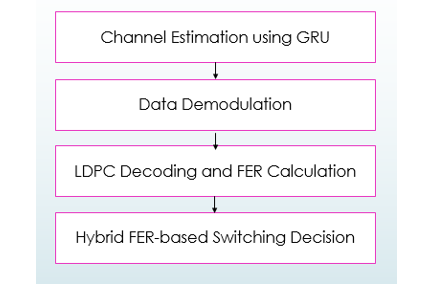
Block Diagram
Specifications
Software: Matlab 2022b or above
Hardware:
Operating Systems:
- Windows 10
- Windows 7 Service Pack 1
- Windows Server 2019
- Windows Server 2016
Processors:
Minimum: Any Intel or AMD x86-64 processor
Recommended: Any Intel or AMD x86-64 processor with four logical cores and AVX2 instruction set support
Disk:
Minimum: 2.9 GB of HDD space for MATLAB only, 5-8 GB for a typical installation
Recommended: An SSD is recommended A full installation of all MathWorks products may take up to 29 GB of disk space
RAM:
Minimum: 4 GB
Recommended: 8 GB
Learning Outcomes
· Introduction to Matlab
· What is EISPACK & LINPACK
· How to start with MATLAB
· About Matlab language
· Matlab coding skills
· About tools & libraries
· Application Program Interface in Matlab
· About Matlab desktop
· How to use Matlab editor to create M-Files
· Features of Matlab
· Basics on Matlab
· What is Communication?
· About Communication
· Introduction to Communication
· How Communication Works?
· Importing the System Design, Characterization and Visualization
· Analyzing of BER tool
· Analyzing of Error Rate Test Console
· Generation of WSN
· WSN network creation
· Nodes Communication
· Clustering
· Routing
· Convolutional
· Equalization and Synchronization etc.,
· How to extend our work to another real time applications
· Project development Skills
o Problem analyzing skills
o Problem solving skills
o Creativity and imaginary skills
o Programming skills
o Deployment
o Testing skills
o Debugging skills
o Project presentation skills
o Thesis writing skills
Demo Video


Request for Video
 Paper Publishing
Request Call Back
Would you like to receive a free callback now?
Choose the best time for callback:
Leave your message and we will contact you as soon as possible

6-2-85/B, Old Maternity Hospital Road, Thyagaraja Nagar, Tirupati, Andhra Pradesh – 517501
+91 9030333433
+91 9393939065
0877-2261612

Disclaimer - Takeoff Edu Group Projects are not associated or affiliated with IEEE in any way. The IEEE Projects mentioned here are mentioned in the context of student projects, whose ideas are derived from IEEE publications, not projects of or by IEEE.

