Growth Prediction of Olive Varieties Based on Climate Parameters
Objective
This project aims to improve the efficiency and sustainability of olive farming by enabling growers to make informed decisions about which varieties to plant and how to manage their crops based on expected growth patterns.
Abstract
Several Methods based on regression techniques are used for the prediction of phenological phases in modern olive growing. This study collects phenological observations and agrometeorological data for several Italian provinces. The aim of the analysis was to provide a geographically tailored value for the base temperature, i.e., the most important parameter in determining the growing Degree Days (GDD): Machine learning methods were compared to optimize phenological predictions and the base temperature for heat unit accumulation. For prediction for the target variable like rainfall, temperature, and relative humidity and evaporation. The use of a low base temperature resulted in better model prediction, which has added value under a warming climate scenario.
Keywords- Phenophase, olive phenology modeling, BBCH scale, machine learning, base temperature
NOTE: Without the concern of our team, please don't submit to the college. This Abstract varies based on student requirements.
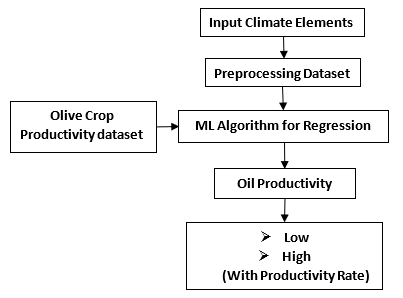
Block Diagram
Specifications
Software: MATLAB 2020a or above
Hardware: Operating Systems:
- Windows 10
- Windows 7 Service Pack 1
- Windows Server 2019
- Windows Server 2016
Minimum: Any Intel or AMD x86-64 processor
Recommended: Any Intel or AMD x86-64 processor with four logical cores and AVX2 instruction set support
Disk:
Minimum: 2.9 GB of HDD space for MATLAB only, 5-8 GB for a typical installation
Recommended: An SSD is recommended A full installation of all Math Works products may take up to 29 GB of disk space
RAM:
Minimum: 4 GB
Recommended: 8 GB
Learning Outcomes
- Introduction to MATLAB
- What are EISPACK and LINPACK?
- How to start with MATLAB
- About Matlab language
- Matlab coding skills
- About tools & libraries
- Application Program Interface in Matlab
- About Matlab desktop
- How to use Matlab editor to create M-Files
- Features of Matlab
- Basics on Matlab
- What is an Image/pixel?
- About image formats
- Introduction to Image Processing
- How digital image is formed
- Importing the image via image acquisition tools
- Analyzing and manipulation of image.
- Phases of image processing:
- Acquisition
- Image enhancement
- Image restoration
- Color image processing
- Image compression
- Morphological processing
- Segmentation etc.,
- How to extend our work to another real time applications
- Project development Skills
- Problem analyzing skills
- Problem solving skills
- Creativity and imaginary skills
- Programming skills
- Deployment
- Testing skills
- Debugging skills
- Project presentation skills
- Thesis writing skills


 Paper Publishing

Request Call Back
Would you like to receive a free callback now?
Choose the best time for callback:
Leave your message and we will contact you as soon as possible

6-2-85/B, Old Maternity Hospital Road, Thyagaraja Nagar, Tirupati, Andhra Pradesh – 517501
+91 9030333433
+91 9393939065
0877-2261612

Disclaimer - Takeoff Edu Group Projects are not associated or affiliated with IEEE in any way. The IEEE Projects mentioned here are mentioned in the context of student projects, whose ideas are derived from IEEE publications, not projects of or by IEEE.

