Grid-Connected Induction Motor Using a Floating DC-Link Converter Under Unbalanced Voltage Sag
Objective
The main objective of the project is to eliminate unbalanced PW current, distorted CW current and oscillations of the PW active or reactive power were analyzed.
Abstract
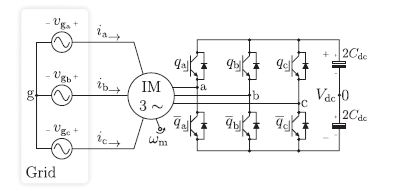
In this project, a series compensator for grid-connected induction motors with unbalanced voltage sag ride-through capability is proposed. A traditional three-phase voltage source inverter (VSI) is designed to regulate motor voltages. The VSI is linked to the grid and a three-phase machine in series with unrestricted windings the proposed system is appropriate for applications requiring no frequency variation, such as large fans or pumps Through the energy minimized compensation (EMC) technique, the VSI dc-link voltage acts as a floating capacitor. Which lacks a dc source and an injection transformer.
The motor load condition determines the minimum grid voltage positive component (sag severity) to keep EMC operation. Meanwhile, a voltage unbalance may increase the dc-link voltage requirements. A 1.5-hp four-pole induction motor has been used to verify the ride-through capability of the proposed compensator under grid voltage disturbances.
A total harmonic distortion (THD) analysis of grid currents demonstrates that the proposed system provides low THD even if no passive filter is used. The operating principle, converter output voltage analysis, pulse width modulation technique, control strategy, and components ratings are discussed as well. Simulation results are presented to demonstrate the feasibility of the system
Keywords: Floating capacitor, induction motor, series compensator, unbalanced voltage sag.
NOTE: Without the concern of our team, please don't submit to the college. This Abstract varies based on student requirements.
Block Diagram
Specifications
Software Configuration:
Operating System : Windows 7/8/10
Application Software : Matlab/Simulink
Hardware Configuration:
RAM : 8 GB
Processor : I3 / I5(Mostly prefer)
Learning Outcomes
- Introduction to Matlab/Simulink
- What is EISPACK & LINPACK
- How to start with MATLAB
- About Matlab language
- About tools & libraries
- Application of Matlab/Simulink
- About Matlab desktop
- Features of Matlab/Simulink
- Basics on Matlab/Simulink
- Types of transformation
- Types of PWM
- Introduction to doubly fed induction generator
- Introduction to grid side converters
- Introduction to machine side converters
- Introduction to Low Voltage Ride Through
- Introduction to Voltage Source Inverter
- Introduction to PI Controllers
- Introduction to High Frequency Carrier Signal
- Introduction to Comparators
- Introduction to Inverse Clarks transformation
- Introduction to Inverse parks transformation
- Introduction to abc to dqo transformation
- Introduction to dqo to abc transformation
- Brief discussion about dc link voltage controller
- Brief discussion about parks transformation
- Brief discussion about Clarks transformation
- Brief discussion about inverse parks transformation
- Brief discussion about inverse Clarks transformation
- Project Development Skills:
- Problem analyzing skills
- Problem solving skills
- Creativity and imaginary skills
- Programming skills
- Deployment
- Testing skills
- Debugging skills
- Project presentation skills
- Thesis writing skills
Demo Video


Request for Video
 Paper Publishing
Request Call Back
Would you like to receive a free callback now?
Choose the best time for callback:
Leave your message and we will contact you as soon as possible

6-2-85/B, Old Maternity Hospital Road, Thyagaraja Nagar, Tirupati, Andhra Pradesh – 517501
+91 9030333433
+91 9393939065
0877-2261612

Disclaimer - Takeoff Edu Group Projects are not associated or affiliated with IEEE in any way. The IEEE Projects mentioned here are mentioned in the context of student projects, whose ideas are derived from IEEE publications, not projects of or by IEEE.

