Green AI for Smart Agriculture: Energy-Efficient Predictive Models for Crop Yield and Resource Management
Objective
To develop energy-efficient AI models for predicting crop yield and optimizing resource utilization such as water, fertilizers, and energy in smart agriculture systems. To implement Green AI techniques that reduce computational power consumption while maintaining high prediction accuracy, promoting sustainable and environmentally responsible farming practices.
Abstract
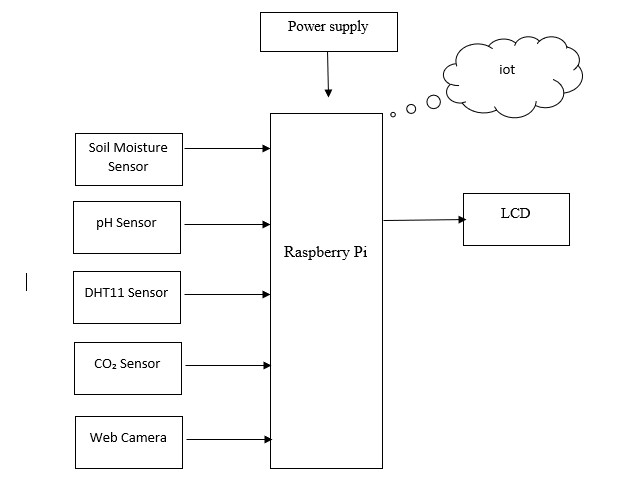
The Green AI for Smart Agriculture: Energy-Efficient Predictive Models for Crop Yield and Resource Management system is developed to enhance agricultural productivity through intelligent monitoring and predictive analysis using energy-efficient AI techniques. The proposed system integrates multiple environmental sensors including a soil moisture sensor to assess soil condition, a pH sensor to measure soil quality, a DHT11 sensor for temperature and humidity monitoring, and a CO₂ sensor to evaluate environmental gas concentration affecting crop growth. A web camera is used for crop observation and detection, while a Raspberry Pi acts as the central processing unit for data acquisition and analysis. The collected agricultural parameters are uploaded to the ThingSpeak IoT cloud platform for monitoring and storage. A Machine Learning model based on the Random Forest algorithm analyzes sensor data to predict crop yield conditions and optimize resource management such as irrigation and soil maintenance. The monitored parameters and prediction results are displayed on an LCD module for farmer awareness. This system supports sustainable and energy-efficient smart agriculture by enabling data-driven decision-making, improved crop management, and optimized utilization of agricultural resources.
NOTE: Without the concern of our team, please don't submit to the college. This Abstract varies based on student requirements.
Block Diagram
Specifications
Hardware components:
· Raspberry Pi
· Memory Card
· Web Camera
· Soil Moisture Sensor
· pH Sensor
· DHT11 Sensor
· CO₂ Sensor
· LCD Display
· Power Supply
· Adapter
Software requirements:
· Raspbian OS
· Python
Learning Outcomes
Learning Outcomes
- Understanding Raspberry Pi architecture and pin configuration
- Installation and setup of Raspberry Pi OS
- Software installation and system configuration for Raspberry Pi
- Introduction to Raspberry Pi development environment
- Basic programming using Python for embedded applications
- Fundamentals of Embedded Systems programming
- Basics of IoT platforms and cloud connectivity
- Understanding power supply and hardware interfacing
- Knowledge of sensor interfacing with Raspberry Pi
Project Development Life Cycle
- Planning and Requirement Gathering (hardware, software, and tools)
- Circuit and schematic preparation
- Program development and debugging
- Hardware interfacing and troubleshooting
- System integration and output testing
Practical Exposure
- Working with hardware and software tools
- Developing solutions for practical monitoring systems
- Individual and team-based project implementation
- Implementation of innovative and creative ideas
Skills Developed
- Embedded system development
- Problem analysis
- Problem solving
- Programming skills
- Creativity and innovation
- System deployment
- Testing and validation
- Debugging techniques
- Project presentation
- Technical documentation and thesis writing


 Paper Publishing

Request Call Back
Would you like to receive a free callback now?
Choose the best time for callback:
Leave your message and we will contact you as soon as possible

6-2-85/B, Old Maternity Hospital Road, Thyagaraja Nagar, Tirupati, Andhra Pradesh – 517501
+91 9030333433
+91 9393939065
0877-2261612

Disclaimer - Takeoff Edu Group Projects are not associated or affiliated with IEEE in any way. The IEEE Projects mentioned here are mentioned in the context of student projects, whose ideas are derived from IEEE publications, not projects of or by IEEE.

