GPS GSM based School Bus Boarding Deboarding and Location Notifying System
Objective
The main objective of this project is to implement a GPS/GSM-based system for school buses that tracks and notifies parents and school authorities about the boarding, deboarding, and real-time location of students, ensuring their safety during school transportation.
Abstract
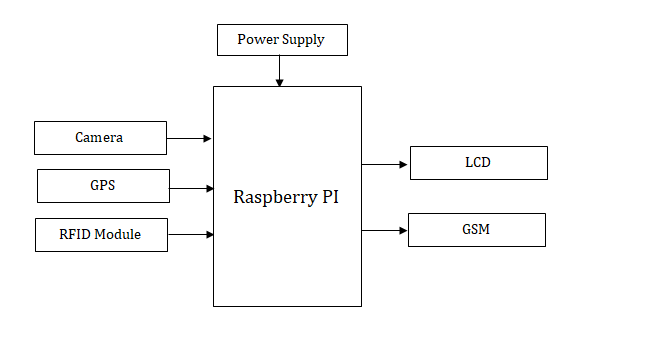
Ensuring the safety and security of students during school transportation is of paramount importance. This project introduces a GPS GSM-based School Bus Boarding, Deboarding, and Location Notifying System designed to enhance the security of students during their school bus journeys. The system incorporates essential components, including a Raspberry Pi microcomputer, GPS for location tracking, RFID for boarding and deboarding detection, a camera for capturing entry and exit images, an LCD display for data visualization, and a GSM module for sending SMS notifications to parents, including the location as a link.
The system operates by continuously monitoring students' school bus journeys. RFID technology is used to detect when a student boards and deboards the bus. Upon boarding, a student's entry is recorded along with an image captured by the camera. When a student deboards, the system records the event and captures an exit image. Simultaneously, GPS technology is employed to track the bus's location throughout the journey. The system then uses a GSM module to send SMS notifications to parents, indicating when their child has boarded and deboarded the bus and including a location link for added assurance. Including boarding and deboarding events, images, and location information, is displayed on the LCD.
This innovative system offers a comprehensive solution for ensuring the safety of students during school bus transportation. It not only provides monitoring but also enhances the communication and transparency between schools and parents. The combination of RFID, GPS, and GSM technologies ensures that parents are well-informed about their child's whereabouts throughout the journey, contributing to their peace of mind and the overall safety of students. Further research and testing will be essential to validate its performance in scenarios and refine its features for implementation.
Keywords: Raspberry PI, Child safety, RFID, GSM, LCD
NOTE: Without the concern of our team, please don't submit to the college. This Abstract varies based on student requirements.
Block Diagram
Specifications
Hardware Components:
- Raspberry PI
- GPS
- RFID module
- RFID tags
- Camera
- LCD
- GSM
Software Components:
- Rasbian OS
- Python
Learning Outcomes
- Raspberry pin diagram and architecture
- How to install Raspbian OS
- Setting up and installation procedure for Raspberry
- Introduction to Raspberry
- Basic coding in Raspberry
- Working of power supply
- Working of LCD
- Interface LCD with Raspberry PI
- About Project Development Life Cycle:
- Planning and Requirement Gathering (software’s, Tools, Hardware components, etc.,)
- Schematic preparation
- Code development and debugging
- Hardware development and debugging
- Development of the Project and Output testing
- Practical exposure to:
- Hardware and software tools.
- Solution providing for real time problems.
- Working with team/ individual.
- Work on Creative ideas.
- Project development Skills
- Problem analyzing skills
- Problem solving skills
- Creativity and imaginary skills
- Programming skills
- Deployment
- Testing skills
- Debugging skills
- Project presentation skills


 Paper Publishing

Request Call Back
Would you like to receive a free callback now?
Choose the best time for callback:
Leave your message and we will contact you as soon as possible

6-2-85/B, Old Maternity Hospital Road, Thyagaraja Nagar, Tirupati, Andhra Pradesh – 517501
+91 9030333433
+91 9393939065
0877-2261612

Disclaimer - Takeoff Edu Group Projects are not associated or affiliated with IEEE in any way. The IEEE Projects mentioned here are mentioned in the context of student projects, whose ideas are derived from IEEE publications, not projects of or by IEEE.

