Glaucoma detection using DL and IOT
Objective
In this project, we are aiming to create an application to detect Glaucoma based on the images of optic retinal images. As, glaucoma is the main cause of irreversible vision loss that which is to be cured at initial stages.
Abstract
Glaucoma is a major global cause of blindness. It is currently the main cause of irreversible vision loss and is caused by high intraocular pressure pushing against the optic nerve in the eye. The damaged nerve fiber leads to a larger optic cup region and thinning of the inferior rim around the optic nerve. As the symptoms of glaucoma appear, when the disease reaches an advanced stage, proper screening of glaucoma in the early stages is challenging. Therefore, regular glaucoma screening is essential and recommended.
However, eye screening is currently subjective, time-consuming and labor-intensive and there are insufficient eye specialists available. A novel approach is proposed for glaucoma detection using the perimeter method of fractal analysis. The Normal and glaucoma defected image is classified and detected by digital image processing by CNN method and implemented using IOT.
Keywords: Glaucoma; Retinal Images; Optic Disc Segmentation; Deep Learning; Deep Activated Features; Fractal Analysis.
NOTE: Without the concern of our team, please don't submit to the college. This Abstract varies based on student requirements.
Block Diagram
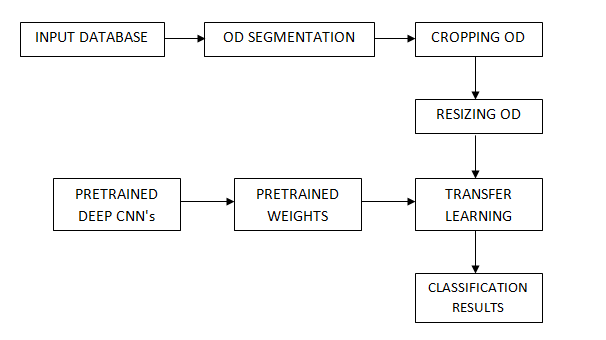
Specifications
HARDWARE SPECIFICATIONS:
- Processor: I3/Intel
- Processor RAM: 4GB (min)
- Hard Disk: 128 GB
- Key Board: Standard Windows Keyboard
- Mouse: Two or Three Button Mouse
- Monitor: Any
SOFTWARE SPECIFICATIONS:
- Operating System: Windows 7+
- Server-side Script: Python 3.6+
- IDE: PyCharm
- Libraries Used: Pandas, Numpy, sklearn, Flask, Seaborn, TensorFlow.
Learning Outcomes
- Importance of Supervised & Unsupervised Learning.
- Scope of Glaucoma detection.
- Use of CNN.
- What are pre trained models.
- Importance of PyCharm IDE.
- Benefits of pre trained models.
- Implementation of IoT system.
- Process of debugging a code.
- The problem with imbalanced dataset.
- Benefits of SMOTE technique.
- Input and Output modules
- How test the project based on user inputs and observe the output
- Project Development Skills:
- Problem analyzing skills.
- Problem solving skills.
- Creativity and imaginary skills.
- Programming skills.
- Deployment.
- Testing skills.
- Debugging skills.
- Project presentation skills.
- Thesis writing skills.


 Paper Publishing

Request Call Back
Would you like to receive a free callback now?
Choose the best time for callback:
Leave your message and we will contact you as soon as possible

6-2-85/B, Old Maternity Hospital Road, Thyagaraja Nagar, Tirupati, Andhra Pradesh – 517501
+91 9030333433
+91 9393939065
0877-2261612

Disclaimer - Takeoff Edu Group Projects are not associated or affiliated with IEEE in any way. The IEEE Projects mentioned here are mentioned in the context of student projects, whose ideas are derived from IEEE publications, not projects of or by IEEE.

