From Synthetic Data to Real-World Efficiency: Automated Vehicle Damage Detection and Vehicle Parts Segmentation.
Objective
The objective of this project is to develop an automated system for vehicle damage detection and vehicle parts segmentation using synthetic data to enhance real-world efficiency. The system aims to streamline vehicle inspections by accurately identifying damages, such as broken glass, broken lights, cracks, and scratches, while also segmenting vehicle parts into 28 different components. The project leverages the SYNDCAR dataset, which includes high-resolution images with detailed annotations. Three advanced models—YOLOv9, YOLO26, and DA-ViT-YOLO (Domain-Adaptive Vision Transformer YOLO)—are employed to detect damages and segment parts. The use of synthetic data, in combination with these models, addresses the limitations of traditional vehicle inspection systems by enabling better generalization and scalability. The ultimate goal is to provide an efficient, automated solution for vehicle damage detection and parts segmentation, improving vehicle maintenance processes and offering cost-effective solutions to the automotive industry.
Abstract
This project focuses on developing an automated system for vehicle damage detection and vehicle parts segmentation, utilizing synthetic data to improve real-world efficiency. The dataset, SYNDCAR, consists of 245 high-resolution images with annotations for both vehicle damage (broken glass, broken lights, cracks, scratches) and vehicle parts (28 different components). The project aims to automate the identification of damages and the segmentation of vehicle parts to streamline vehicle inspections. Three different models are employed: YOLOv9, YOLO26, and DA-ViT-YOLO (Domain-Adaptive Vision Transformer YOLO). The models are trained on the SYNDCAR dataset and evaluated for their performance on detecting damages and segmenting vehicle parts. The use of synthetic data, combined with these advanced models, allows the system to overcome the limitations of traditional vehicle inspection systems. By focusing on domain adaptation and leveraging state-of-the-art detection algorithms, this system provides an efficient, scalable, and automated solution for vehicle damage detection and parts segmentation, paving the way for enhanced vehicle maintenance processes and cost-effective solutions for the automotive industry.
Keywords: Automated Vehicle Damage Detection, Vehicle Parts Segmentation, YOLOv9, YOLO26, DA-ViT-YOLO, Synthetic Data, Computer Vision, Domain Adaptation.
NOTE: Without the concern of our team, please don't submit to the college. This Abstract varies based on student requirements.
Block Diagram
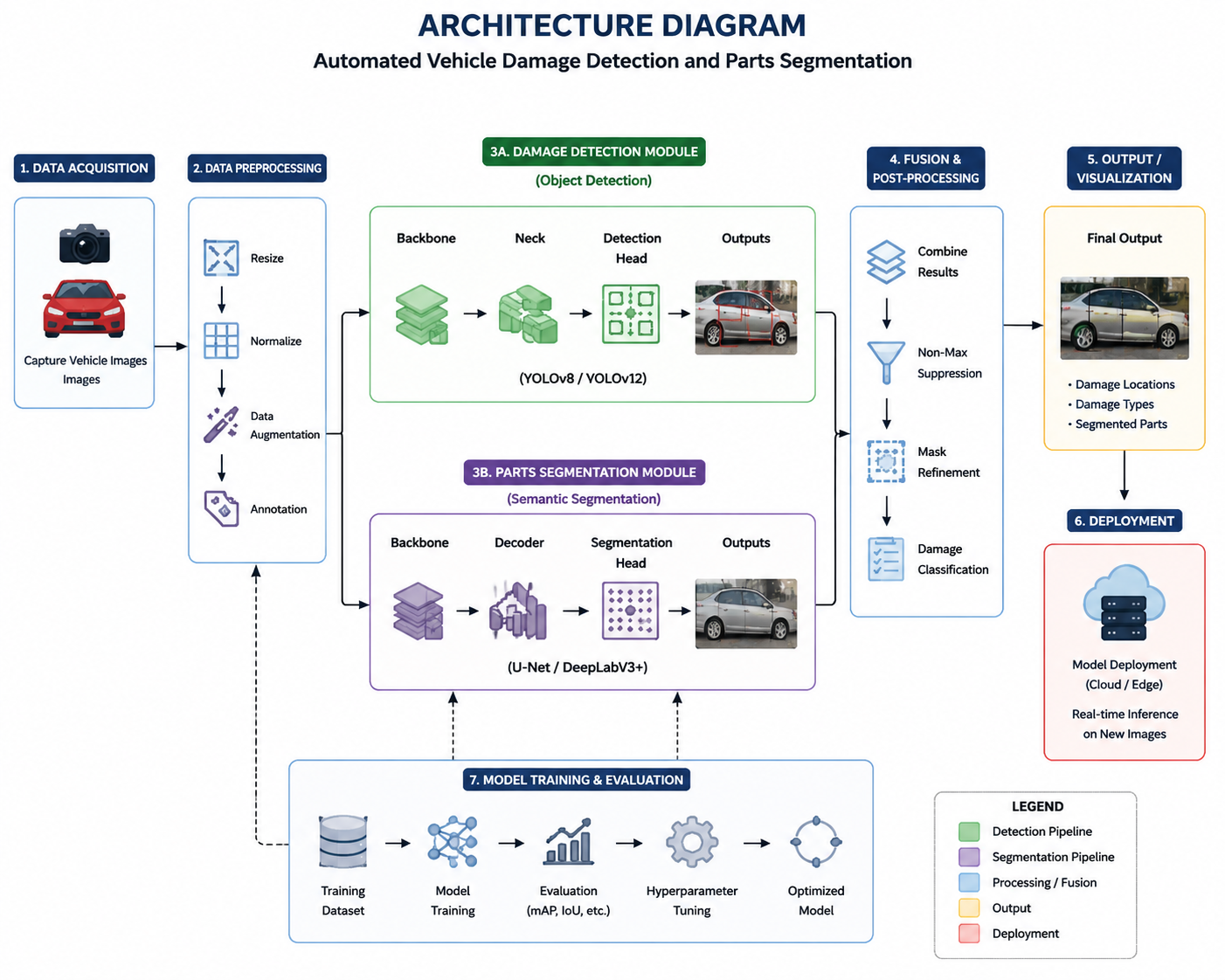
Specifications
SOFTWARE REQUIREMENS
Operating System : Windows 7/8/10
Server side Script : HTML, CSS & JS
Programming Language : Python
Libraries : YOLOv9, YOLO26, DA-ViT-YOLO, TensorFlow, PyTorch, OpenCV, NumPy, Matplotlib, Flask, Keras, CVAT, TensorRT, ONNX, OpenVINO, Ray Tune, CUDA
IDE/Workbench : VSCode
Server Deployment : MYSQL
Database : MySQL
HARDWARE REQUIREMENTS
Processor - I3/Intel Processor
RAM - 8GB (min)
Hard Disk - 128 GB
Key Board - Standard Windows Keyboard
Mouse - Two or Three Button Mouse
Monitor - Any


 Paper Publishing

Request Call Back
Would you like to receive a free callback now?
Choose the best time for callback:
Leave your message and we will contact you as soon as possible

6-2-85/B, Old Maternity Hospital Road, Thyagaraja Nagar, Tirupati, Andhra Pradesh – 517501
+91 9030333433
+91 9393939065
0877-2261612

Disclaimer - Takeoff Edu Group Projects are not associated or affiliated with IEEE in any way. The IEEE Projects mentioned here are mentioned in the context of student projects, whose ideas are derived from IEEE publications, not projects of or by IEEE.

