FPGA Based Low Power Approximate Hybrid Parallel Prefix Adders with Less Area
Objective
Design Hybrid Parallel Prefix Adders with Approximation • Develop hybrid parallel prefix adder architectures (e.g., combining exact logic in MSBs and approximate logic in LSBs) to balance accuracy and hardware efficiency. • Incorporate approximate prefix operators (AxPOs) or simplified carry logic in least significant portions to reduce complexity.
Abstract
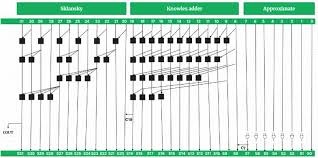
Approximate parallel prefix adders (AxPPA) are a type of circuit that can perform addition operations on binary numbers with high speed and low power consumption with less area. These circuits provide approximate results, which means that they sacrifice accuracy for efficiency. This trade off makes them ideal for use in applications where speed is more important than precision. In recent years, there has been a growing interest in the development of these circuits, as they have the potential to revolutionize the field of digital signal processing. In this paper, an overview of approximate parallel prefix adders and methods for reducing the error rate of AxPPA by modification of the architectures for the following PPA adders: approximate Knowles (AxKWPPA), and Sklansky (AxSKPPA). The proposed adders aim at reduce the area, delay and Power delay Product. These proposed adders designed, simulated and implemented with Verilog HDL (IEEE 1364-2005), Xilinx Vivado software tool (Xilinx Vivado2018.1) and Digilent Artix7 FPGA board (XC7A35TICSG324-1L) respectively. The proposed adders verified by implementing them in FPGA In the Loop for the image enhancement and contrast applications.
NOTE: Without the concern of our team, please don't submit to the college. This Abstract varies based on student requirements.
Block Diagram
Specifications
. Specifications:
Software Requirements:
· Xilinx ISE Tool/Xilinx Vivado
· HDL: Verilog
Learning Outcomes
Learning Outcomes
· Understanding the basics of digital arithmetic circuits, including adders and parallel prefix structures.
· Introduction to Verilog HDL coding for designing combinational and sequential circuits.
· Hands-on experience with FPGA design and simulation using Xilinx Vivado.
· Learn how to analyze and extract key parameters such as power, area, and delay.
· Understanding the trade-off between accuracy, power, and area in approximate computing.
· Knowledge of parallel prefix adder architectures such as Kogge–Stone and Brent–Kung.
· Exposure to low-power design techniques, including clock gating and approximation.
· Practical experience with FPGA resource optimization, including LUTs, registers, and routing.
· Understanding the applications of approximate arithmetic in error-tolerant systems like image processing and AI.
· Development of real-world skills in designing efficient digital circuits for low-power embedded systems.


 Paper Publishing

Request Call Back
Would you like to receive a free callback now?
Choose the best time for callback:
Leave your message and we will contact you as soon as possible

6-2-85/B, Old Maternity Hospital Road, Thyagaraja Nagar, Tirupati, Andhra Pradesh – 517501
+91 9030333433
+91 9393939065
0877-2261612

Disclaimer - Takeoff Edu Group Projects are not associated or affiliated with IEEE in any way. The IEEE Projects mentioned here are mentioned in the context of student projects, whose ideas are derived from IEEE publications, not projects of or by IEEE.

