Forecasting demand for water pump

Project Code :TCMAPY1561

Objective

The primary objective of this project is to develop a robust machine learning-based model for forecasting net groundwater availability in various regions.

Abstract

The growing concern about water scarcity and the importance of sustainable water management have led to the need for accurate forecasting of groundwater availability. This project, titled "Forecasting Net Ground Water Availability Using Machine Learning," aims to predict the future availability of groundwater resources based on various factors, including historical water usage data, climatic conditions, and regional characteristics. The project employs a range of machine learning algorithms, including Support Vector Machine (SVM), Long Short-Term Memory (LSTM), Random Forest, Stacking Classifier, and XGBoost, to develop accurate models for predicting groundwater levels in different regions.The SVM algorithm is used for its ability to handle high-dimensional data and provide precise boundaries between classes, making it suitable for classification tasks within the dataset. LSTM, a type of recurrent neural network, is implemented to capture temporal dependencies and long-term trends in groundwater levels. Random Forest, an ensemble learning method, is employed to improve accuracy and reduce overfitting by aggregating predictions from multiple decision trees. The Stacking Classifier further enhances model performance by combining the predictions of individual models for more robust and reliable results. Lastly, XGBoost, known for its speed and performance, is applied to improve the prediction of groundwater availability by minimizing errors and optimizing model performance. The results from these models are then analyzed to provide valuable insights into future groundwater availability, helping in the efficient management of water resources. This project contributes to the growing need for data-driven solutions in sustainable water management. Keywords: Groundwater Availability, Water Scarcity, Sustainable Water Management, Machine Learning, Support Vector Machine (SVM), Long Short-Term Memory (LSTM), Random Forest, Stacking Classifier, XGBoost, Water Resource Management, Predictive Modeling, Temporal Dependencies, Ensemble Learning, Data-Driven Solutions, Climatology, Regional Characteristics, Groundwater Forecasting, Water Usage Data.

NOTE: Without the concern of our team, please don't submit to the college. This Abstract varies based on student requirements.

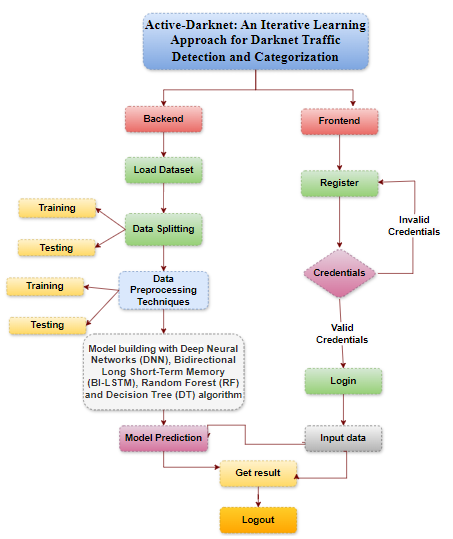
Block Diagram
Specifications

 H/W CONFIGURATION: 

  ·         Processor                                 - I3/Intel Processor

·         Hard Disk                                - 160GB 

  ·         Key Board                              - Standard Windows Keyboard 

  ·         Mouse                                     - Two or Three Button Mouse

·         Monitor                                   - SVGA

·         RAM                                       - 8GB 

  S/W CONFIGURATION:

·         Operating System                   :  Windows 7/8/10

·         Server side Script                    :  HTML, CSS, Bootstrap & JS

·         Programming Language         :  Python 

  ·         Libraries                                  :  Flask, Pandas, MySQL. Connector, Os, Smtplib, Numpy

·         IDE/Workbench                      :  PyCharm

·         Technology                             :  Python 3.6+ 

  ·         Server Deployment                 :  Xampp Server

Demo Video

mail-banner
call-banner
contact-banner
Request Video




