Forecasting and Performance Analysis of Energy Production in Solar Power Plants Using Long Short-Term Memory (LSTM) and Random Forest Models
Objective
This study uses Long Short-Term Memory (LSTM) and Random Forest models to forecast and analyze the performance of energy production in solar power plants, aiming to enhance prediction accuracy and optimize energy management.
Abstract
The integration of machine learning techniques such as Long Short-Term Memory (LSTM) and Random Forest models enhances the efficiency and reliability of power plant monitoring systems. This project utilizes Raspberry Pi and Arduino to interface various sensors, including voltage and current sensors for monitoring electrical parameters, a vibration sensor to detect motor irregularities, and temperature sensors (DHT11 and DS18B20) to assess heat variations. Additionally, an MQ6 gas sensor ensures safety by detecting gas leaks. In case of any abnormal conditions, the system triggers alerts via a GSM module and a buzzer. The collected data is processed using LSTM for sequential pattern recognition and Random Forest for classification and anomaly detection, enabling predictive maintenance and fault prevention. This IoT-based smart monitoring system ensures improved safety, efficiency, and real-time fault detection in power plants.
NOTE: Without the concern of our team, please don't submit to the college. This Abstract varies based on student requirements.
Block Diagram
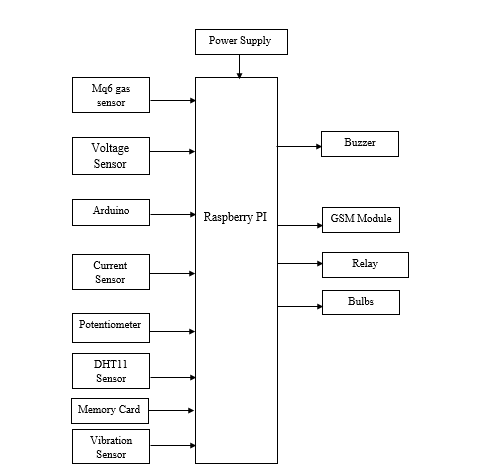
Specifications
Hardware requirements:
- - Raspberry Pi
- - Arduino
- - Voltage Sensor
- - Current Sensor
- - Vibration Sensor
- - Temperature Sensor
- - MQ6 Gas Sensor
- - Potentiometer
- - Relay
- - Bulbs (200W, 60W)
- - GSM Module
- - Buzzer
- - Memory Card
Software requirements:
- Raspian os
- Python IDLE
Learning Outcomes
- - Understanding the architecture and pin configuration of Raspberry Pi and Arduino
- - Installing and configuring Arduino IDE and Raspberry Pi setup
- - Interfacing voltage, current, vibration, and temperature sensors with Raspberry Pi and Arduino
- - Implementing real-time data acquisition and monitoring
- - Introduction to LSTM and Random Forest algorithms for fault detection
- - Working with GSM module for remote alerts
- - Understanding power supply requirements for Raspberry Pi and Arduino
- About Project Development Life Cycle:
- Planning and Requirement Gathering (software’s, Tools, Hardware components, etc.,)
- Schematic preparation
- Code development and debugging
- Hardware development and debugging
- Development of the Project and Output testing
- Practical exposure to:
- Hardware and software tools.
- Solution providing for real time problems.
- Working with team/ individual.
- Work on Creative ideas.
- Project development Skills
- Problem analyzing skills
- Problem solving skills
- Creativity and imaginary skills
- Programming skills
- Deployment
- Testing skills
- Debugging skills
- Project presentation skills
- Thesis writing skills


 Paper Publishing

Request Call Back
Would you like to receive a free callback now?
Choose the best time for callback:
Leave your message and we will contact you as soon as possible

6-2-85/B, Old Maternity Hospital Road, Thyagaraja Nagar, Tirupati, Andhra Pradesh – 517501
+91 9030333433
+91 9393939065
0877-2261612

Disclaimer - Takeoff Edu Group Projects are not associated or affiliated with IEEE in any way. The IEEE Projects mentioned here are mentioned in the context of student projects, whose ideas are derived from IEEE publications, not projects of or by IEEE.

