Forecasting Air Quality Trends Using Long Short-Term Memory (LSTM) Networks
Objective
To develop and evaluate an LSTM-based model for predicting future air quality by analyzing historical sensor data from multiple air pollution sensors.
Abstract
Air quality is a critical environmental factor affecting public health and well-being. prediction of air quality can enable timely interventions and effective management strategies. This project explores the use of Long Short-Term Memory (LSTM) networks for predicting future air quality based on historical sensor data. We collected data from MQ135, MQ2, and MQ4 sensors, which measure various air pollutants including CO2, methane, and particulate matter. The LSTM model, known for its capability to capture long-term dependencies in time-series data, was employed to forecast air quality over the next few days. Our methodology involved preprocessing sensor data, constructing and tuning the LSTM model, and evaluating its performance using metrics such as Root Mean Squared Error (RMSE) and Mean Absolute Percentage Error (MAPE). The results demonstrated that the LSTM model effectively predicted air quality trends, achieving high accuracy and providing insights into future air pollution levels. The findings suggest that LSTM networks are a promising tool for air quality forecasting, with potential applications in environmental monitoring and public health management.
NOTE: Without the concern of our team, please don't submit to the college. This Abstract varies based on student requirements.
Block Diagram
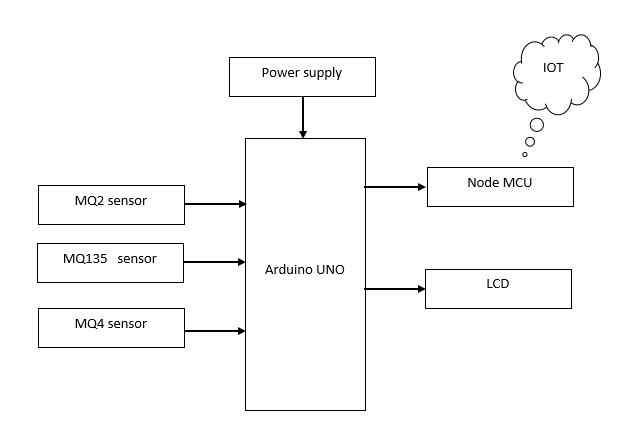
Specifications
Hard ware Requirement:
- Arduino UNO
- MQ2 Sensor
- MQ4 Sensor
- MQ135 Sensor
- Power supply
- Node MCU
Software Requirement:
- Arduino IDE
- Python IDLE
Learning Outcomes
Arduino pin diagram and architecture
How to install Arduino IDE, python IDLE software
Setting up and installation procedure for Arduino
Introduction to Arduino IDE
Basic coding in Arduino IDE
Working of power supply
About Project Development Life Cycle:
Planning and Requirement Gathering (software’s, Tools, Hardware components, etc.,)
Schematic preparation
Code development and debugging
Hardware development and debugging
Development of the Project and Output testing
Practical exposure to:
Hardware and software tools.
Solution providing for real time problems.
Working with team/ individual.
Work on Creative ideas.
Project development Skills
Problem analyzing skills
Problem solving skills
Creativity and imaginary skills
Programming skills
Deployment
Testing skills
Debugging skills
Project presentation skills


 Paper Publishing

Request Call Back
Would you like to receive a free callback now?
Choose the best time for callback:
Leave your message and we will contact you as soon as possible

6-2-85/B, Old Maternity Hospital Road, Thyagaraja Nagar, Tirupati, Andhra Pradesh – 517501
+91 9030333433
+91 9393939065
0877-2261612

Disclaimer - Takeoff Edu Group Projects are not associated or affiliated with IEEE in any way. The IEEE Projects mentioned here are mentioned in the context of student projects, whose ideas are derived from IEEE publications, not projects of or by IEEE.

