For Comparison of Predictive Models for Sentiment Analysis Using Twitter Tweets
Objective
The main objective of the comparison of predictive models for sentiment analysis using Twitter tweets is to evaluate and compare the performance of different machine learning algorithms in accurately predicting sentiment from Twitter data, aiming to identify the most effective model for sentiment analysis tasks.
Abstract
Social media like twitter and Facebook is seen as a space where public opinions are formed in today’s world. The data from these tweets and posts can provide valuable insights for policy makers and other agencies to propose and implement policies better. An attempt is made in this paper to understand the public opinion on the recently implemented demonetization policy in India. A sentiment analysis is carried out on twitter data set using machine learning approaches. Twitter data from November 22nd 2016 to November 23rd 2016 are considered for analysis. The data set is pre-processed for cleaning the data and making it possible for analysis. A final set of 8000 tweets are analyzed using machine learning techniques like Linear Regression, Naïve Bayes, Random forest and Decision tree classifier and the results are compared.
KEYWORDS: Twitter data, Sentiment analysis, Machine learning, Demonetization, Linear Regression, Naïve Bayes, Decision Tree and Random Forest.
NOTE: Without the concern of our team, please don't submit to the college. This Abstract varies based on student requirements.
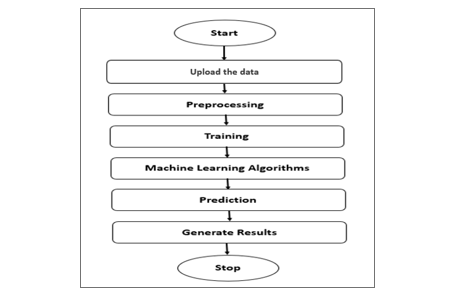
Block Diagram
Specifications
SOFTWARE FRONT END REQUIREMENTS
H/W Configuration:
Operating system: Windows 7 or 7+
RAM: 8 GB
Hard disc or SSD: More than 500 GB
Processor: Intel 3rd generation or high or Ryzen with 8 GB Ram
S/W Configuration:
Software’s: Python 3.6 or high version
IDE : PyCharm.
Framework : Flask


 Paper Publishing

Request Call Back
Would you like to receive a free callback now?
Choose the best time for callback:
Leave your message and we will contact you as soon as possible

6-2-85/B, Old Maternity Hospital Road, Thyagaraja Nagar, Tirupati, Andhra Pradesh – 517501
+91 9030333433
+91 9393939065
0877-2261612

Disclaimer - Takeoff Edu Group Projects are not associated or affiliated with IEEE in any way. The IEEE Projects mentioned here are mentioned in the context of student projects, whose ideas are derived from IEEE publications, not projects of or by IEEE.

