FocusWave A Machine Learning Approach to Personalized Focus Optimization
Objective
FocusWave utilizes behavioral and environmental data, such as activity duration, ambient conditions, and engagement metrics, to assess and optimize user concentration. Using supervised learning models, it predicts focus patterns and suggests personalized interventions like ideal work intervals, rest breaks, and environment adjustments. The system continuously learns from user feedback to refine predictions and boost accuracy. This intelligent platform promotes mental well-being, reduces burnout, and enhances productivity through data-driven insights. The solution can be integrated into smart workplaces or learning environments for personalized performance enhancement.
Abstract
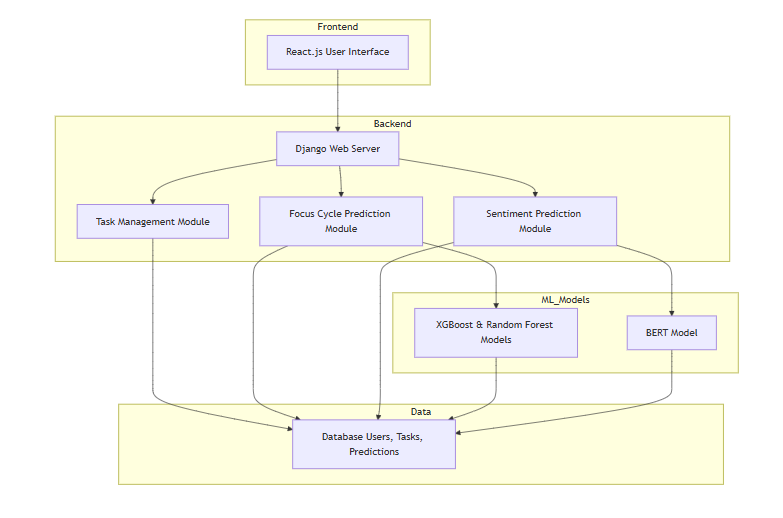
Maintaining consistent concentration and mental stability has become increasingly complex in multitasking digital environments. FocusWave introduces an adaptive focus optimization framework designed to enhance user attention patterns and emotional awareness using intelligent computational models. The system integrates dual predictive models, namely XGBoost and Random Forest, for focus cycle prediction, and a BERT-based sentiment analysis model for emotional state detection from text. The XGBoost and Random Forest models analyze behavioral and contextual features such as engagement level, distraction frequency, mood score, and task category to predict the optimal duration for the next focus cycle. Simultaneously, the BERT model processes text input to classify emotions such as happiness, sadness, or anger, providing a detailed understanding of user sentiment and psychological readiness.
The Django-based web platform enables users to record activities, monitor focus performance, and receive dynamic recommendations for task continuation or recovery breaks. Through predictive insights and emotion-aware feedback, FocusWave supports balanced attention cycles, sustained cognitive performance, and improved task engagement. The framework bridges behavioral analytics and emotional computing, contributing to adaptive human–machine interaction and productivity enhancement.
Keywords: Focus Optimization, Machine Learning, Cognitive Modeling, Emotion Detection, Random Forest, XGBoost, BERT, Django Framework, TF-IDF, Human–Computer Interaction, Productivity Enhancement.NOTE: Without the concern of our team, please don't submit to the college. This Abstract varies based on student requirements.
Block Diagram
Specifications
H/W CONFIGURATION:
Processor - I3/Intel Processor
Hard Disk - 160GB
Key Board - Standard Windows Keyboard
Mouse - Two or Three Button Mouse
Monitor - SVGA
RAM - 8GB
S/W CONFIGURATION:
• Operating System : Windows 7/8/10
• Server side Script : React.js
• Programming Language : Python
• Libraries : Django,
• IDE/Workbench : VS Code
• Technology : Python 3.8+
• Server Deployment : Xampp Server, Mysql


 Paper Publishing

Request Call Back
Would you like to receive a free callback now?
Choose the best time for callback:
Leave your message and we will contact you as soon as possible

6-2-85/B, Old Maternity Hospital Road, Thyagaraja Nagar, Tirupati, Andhra Pradesh – 517501
+91 9030333433
+91 9393939065
0877-2261612

Disclaimer - Takeoff Edu Group Projects are not associated or affiliated with IEEE in any way. The IEEE Projects mentioned here are mentioned in the context of student projects, whose ideas are derived from IEEE publications, not projects of or by IEEE.

