Foc Transformation For Single Open-phase Faults In The Five-phase Open-end Winding Topology
Abstract
FOC Transformation for Single Open- Phase Faults in the Five-Phase Open-End Winding Topology.
Abstract:
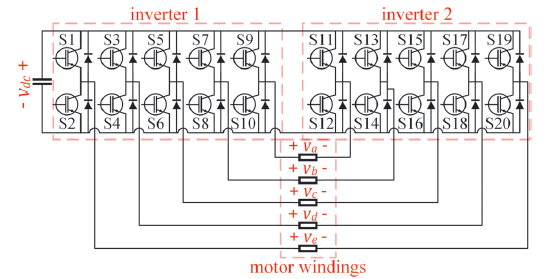
Many critical five-phase PMSM drive systems require operation after a single open-phase fault. The single dc supply open-end winding inverter topology allows for the injection of four unbalanced phase currents to better optimize the post-fault machine torque after this fault. However, all previously published field-oriented control schemes send varying current references to the PI current controllers when controlling four unbalanced phase currents. This makes the design of the PI controllers considerably difficult as each machine operating point will require a different gain to accurately track the varying reference with minimum ripple. Consequently, this paper proposes a new post-fault transformation matrix which obtains constant current references for any given set of four unbalanced sinusoidal phase currents. This facilitates easy design of the PI current controllers as the steady-state error can be reduced to zero in a user-defined response time for all operating points. This current control technique is he first to be designed specifically for the case of an open-phase fault to a five-phase open-end winding system.
NOTE: Without the concern of our team, please don't submit to the college. This Abstract varies based on student requirements.
Block Diagram
Specifications
Software Configuration:
Operating System : Windows 7/8/10
Application Software : Matlab/Simulink
Hardware Configuration:
RAM : 8 GB / 4 GB (Min)
Processor : I3 / I5(Mostly prefer)
Learning Outcomes
- Introduction to Matlab/Simulink
- What is EISPACK & LINPACK
- How to start with MATLAB
- About Matlab language
- About tools & libraries
- Application of Matlab/Simulink
- About Matlab desktop
- Features of Matlab/Simulink
- Basics on Matlab/Simulink
- Introduction to controllers.
- Study of PWM techniques.
- Project Development Skills:
- Problem analyzing skills
- Problem solving skills
- Creativity and imaginary skills
- Programming skills
- Deployment
- Testing skills
- Debugging skills
- Project presentation skills
- Thesis writing skills


 Paper Publishing

Request Call Back
Would you like to receive a free callback now?
Choose the best time for callback:
Leave your message and we will contact you as soon as possible

6-2-85/B, Old Maternity Hospital Road, Thyagaraja Nagar, Tirupati, Andhra Pradesh – 517501
+91 9030333433
+91 9393939065
0877-2261612

Disclaimer - Takeoff Edu Group Projects are not associated or affiliated with IEEE in any way. The IEEE Projects mentioned here are mentioned in the context of student projects, whose ideas are derived from IEEE publications, not projects of or by IEEE.

