FLOOD RISK PREDICTION
Objective
The primary objectives of this project revolve around building an effective flood risk prediction system. Data collection and preprocessing focus on gathering meteorological and geographical data, followed by essential steps such as handling missing values, scaling features, and selecting the most relevant ones to ensure high-quality input for modeling. Model development involves implementing advanced machine learning techniques specifically TabNet, Stacking Classifier, and Voting Classifier to accurately predict flood risk levels from the prepared data. System development centers on creating a secure web-based platform that enables users to register, log in, input data, and obtain flood risk classifications using the trained models. Performance evaluation is conducted through standard metrics including accuracy, precision, recall, and F1-score to rigorously assess model reliability. The user interface is designed to be intuitive and user-friendly, utilizing HTML, CSS, and JavaScript to facilitate seamless interaction and clear interpretation of prediction results. Finally, model optimization is achieved through hyperparameter fine-tuning and the exploration of ensemble methods to further enhance overall prediction accuracy and robustness.
Abstract
Flood risk prediction is crucial for minimizing the damage caused by floods and improving disaster preparedness. This project focuses on building a flood risk prediction system using a dataset that includes weather and geographical data. The system leverages advanced machine learning algorithms like TabNet, Stacking, and Voting Classifier to predict flood risks based on various input features such as rainfall, temperature, and humidity. The model is implemented using Python, with a user-friendly interface developed using HTML, CSS, and JavaScript. The back-end uses the Flask framework to process the data, train models, and deliver predictions. The system's modules include user registration, login, flood risk classification, and performance evaluation. By combining multiple models through ensemble methods, the system aims to provide more accurate and reliable flood risk classifications. This project will contribute to improving decision-making processes and assist in flood risk management efforts.
Keywords: Flood risk, prediction system, machine learning, TabNet, Stacking Classifier, Voting Classifier, Flask, ensemble models, weather data, geographical features.
NOTE: Without the concern of our team, please don't submit to the college. This Abstract varies based on student requirements.
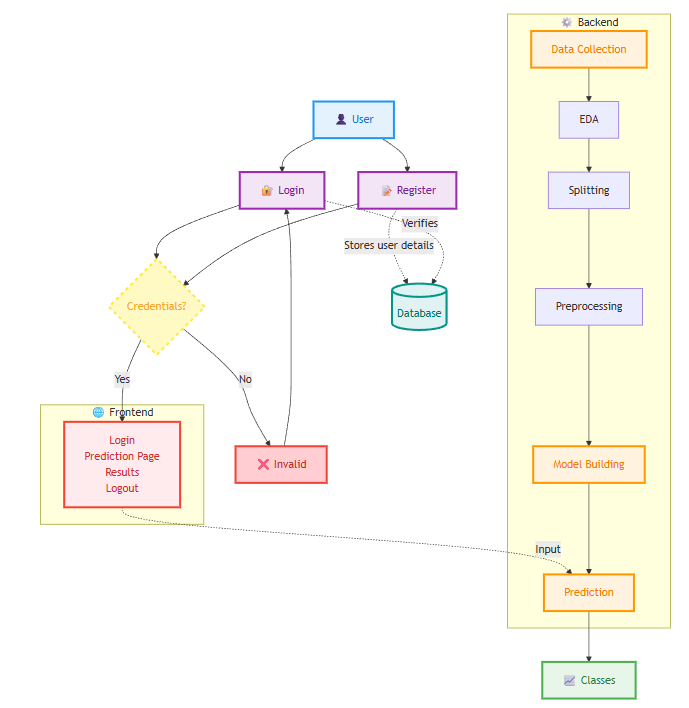
Block Diagram
Specifications
Hardware Requirements
Processor - I3/Intel Processor
Hard Disk - 160GB
Key Board - Standard Windows Keyboard
Mouse - Two or Three Button Mouse
Monitor - SVGA
RAM - 8GB
Software Requirements:
Operating System : Windows 7/8/10
Server side Script : HTML, CSS, Bootstrap & JS
Programming Language : Python
Libraries : Flask/Django, Pandas, Mysql.connector, Os, Smtplib, Numpy
IDE/Workbench : PyCharm
Technology : Python 3.6+
Server Deployment : Xampp Server
Database : MySQL


 Paper Publishing

Request Call Back
Would you like to receive a free callback now?
Choose the best time for callback:
Leave your message and we will contact you as soon as possible

6-2-85/B, Old Maternity Hospital Road, Thyagaraja Nagar, Tirupati, Andhra Pradesh – 517501
+91 9030333433
+91 9393939065
0877-2261612

Disclaimer - Takeoff Edu Group Projects are not associated or affiliated with IEEE in any way. The IEEE Projects mentioned here are mentioned in the context of student projects, whose ideas are derived from IEEE publications, not projects of or by IEEE.

