FLEET FUEL MONITORING SYSTEM WITH IOT
Objective
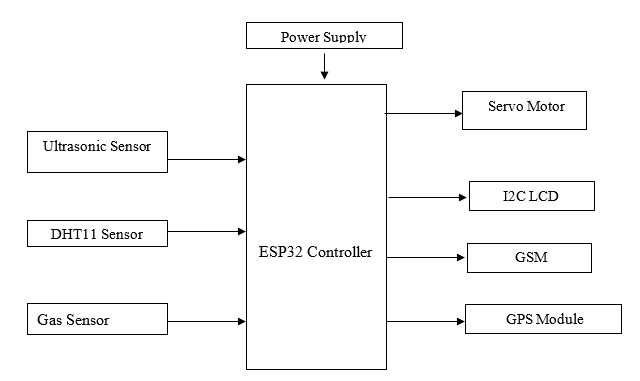
The objective of the Fleet Fuel Monitoring System with IoT is to develop an intelligent and automated fuel monitoring solution for vehicles using IoT technology. The system continuously monitors fuel level, temperature, and gas leakage using sensors connected to an ESP32 microcontroller. It aims to improve vehicle safety, prevent fuel-related issues, and provide real-time monitoring and alerts through GSM, GPS, and ThingSpeak IoT platform for efficient fleet management.
Abstract
The Fleet Fuel Monitoring System with IoT is designed to enhance the efficiency and safety of fuel management in vehicles. An ESP32 microcontroller acts as the central controller, interfacing with an ultrasonic sensor to measure fuel levels and a DHT11 sensor to monitor temperature. A gas sensor is used to detect fuel leakage, while a servo motor controls the fuel door, opening automatically when the fuel level is low. The system integrates GSM and GPS modules to send alerts with the vehicle’s location in case of abnormal conditions such as low fuel, high temperature, or gas leakage. Data is uploaded to the ThingSpeak IoT platform for real-time monitoring and analysis, while an I2C LCD provides local display of fuel and system status. This IoT-enabled solution offers improved safety, operational efficiency, and remote fleet management capabilities.
NOTE: Without the concern of our team, please don't submit to the college. This Abstract varies based on student requirements.
Block Diagram
Specifications
Hardware Components:
- ESP32 Controller
- Ultrasonic Sensor
- DHT11 Sensor
- Gas Sensor
- Servo Motor
- I2C LCD Display
- GSM Module
- GPS Module
- Power Supply
- 12V Adapter
- Connectors
Software Components:
- Arduino IDE
- Embedded C
Learning Outcomes
- Understanding of Embedded Systems and IoT technology
- Knowledge of ESP32 microcontroller programming
- Interfacing and working with sensors like Ultrasonic, DHT11, and Gas Sensor
- Learning GSM and GPS communication techniques
- Understanding real-time fuel monitoring systems
- Knowledge of IoT cloud platforms such as ThingSpeak
- Development of automation and alert systems
- Understanding servo motor control and actuator operations
- Experience in data monitoring and remote tracking
- Improvement in problem-solving and hardware integration skills
Demo Video


Request for Video
 Paper Publishing
Request Call Back
Would you like to receive a free callback now?
Choose the best time for callback:
Leave your message and we will contact you as soon as possible

6-2-85/B, Old Maternity Hospital Road, Thyagaraja Nagar, Tirupati, Andhra Pradesh – 517501
+91 9030333433
+91 9393939065
0877-2261612

Disclaimer - Takeoff Edu Group Projects are not associated or affiliated with IEEE in any way. The IEEE Projects mentioned here are mentioned in the context of student projects, whose ideas are derived from IEEE publications, not projects of or by IEEE.

