Fire Fighting Robot
Objective
The paper not only presents a successful implementation of a fire fighting robot but also presents addition of better features that makes it a more practically usable robot in real time scenarios where acknowledging fire type is important in order to further avoid fire and by using this when the fire detects then automatically water will sprinkle so that can reduce the amount of fire.
Abstract
With the advent of technology, humans are replaced with robots in life-threatening situations. We aim to design a robot capable of detecting and suppressing fires. By designing and implementing an autonomous robot capable of detecting and extinguishing flames, disasters can be avoided with minimal risk to human life. In this research, we illustrate an autonomous robot capable of detecting flames indoors and maneuvering towards the flame to extinguish it with the help of water and also that time the buzzer will alarm.
Keywords: Fire detection and prevention, Arduino UNO, fire sensor, Robot platform
NOTE: Without the concern of our team, please don't submit to the college. This Abstract varies based on student requirements.
Block Diagram
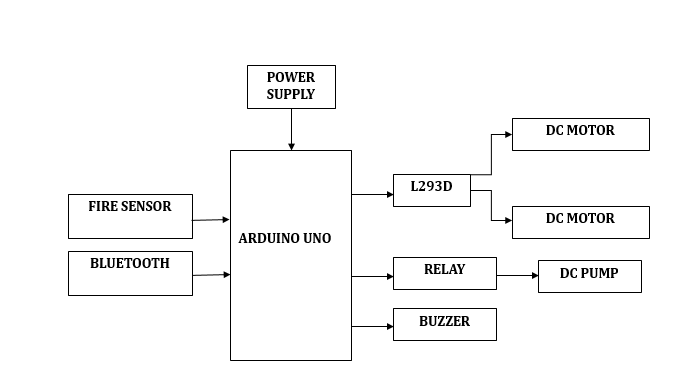
Specifications
Hardware Requirements:
- Arduino UNO
- Power supply
- DC pump
- Relay
- L293D
- DC motor-2
- Bluetooth
- Fire sensor
- Connecting wires
Software Requirements:
- Arduino IDE
- Embedded C
- Fritzing
Learning Outcomes
- Arduino UNO Pin diagram and Architecture
- How to install Arduino IDE
- Setting up and Installation procedures for Arduino IDE
- Introduction to Arduino IDE
- Basic coding in Arduino
- How to install Libraries for Arduino
- What is serial communication?
- Working of buzzer
- How to interface buzzer with Arduino UNO
- Working of relay
- How to interface relay, dc pump with Arduino UNO
- Working of bluetooth
- How to interface bluetooth with Arduino UNO
- About Project Development Life Cycle:
- Planning and Requirement Gathering (software’s, Tools, Hardware components, etc.,)
- Schematic preparation
- Code development and debugging
- Hardware development and debugging
- Development of the Project and Output testing
- Practical exposure to:
- Hardware and software tools.
- Solution providing for real time problems.
- Working with team/ individual.
- Work on Creative ideas.
- Project development Skills
- Problem analyzing skills
- Problem solving skills
- Creativity and imaginary skills
- Programming skills
- Deployment
- Testing skills
- Debugging skills
- Project presentation skills
- Thesis writing skills


 Paper Publishing

Request Call Back
Would you like to receive a free callback now?
Choose the best time for callback:
Leave your message and we will contact you as soon as possible

6-2-85/B, Old Maternity Hospital Road, Thyagaraja Nagar, Tirupati, Andhra Pradesh – 517501
+91 9030333433
+91 9393939065
0877-2261612

Disclaimer - Takeoff Edu Group Projects are not associated or affiliated with IEEE in any way. The IEEE Projects mentioned here are mentioned in the context of student projects, whose ideas are derived from IEEE publications, not projects of or by IEEE.

