FertiForecast: Machine Learning-Based Fertilizer Quality Assessment Using NPK Levels
Objective
The objective of FertiForecast is to enhance agricultural productivity by accurately identifying fertilizer quality based on Nitrogen (N), Phosphorus, and Potassium (NPK) levels. The system leverages Arduino technology combined with machine learning algorithms to provide real-time, automated assessments of fertilizer quality, supporting more informed decision-making for farmers and agricultural professionals.
Abstract
Effective fertilizer management is crucial for optimizing agricultural productivity and sustainability. This study presents FertiForecast, a novel system for identifying fertilizer quality based on Nitrogen (N), Phosphorus (P), and Potassium (K) levels using a combination of Arduino technology and machine learning algorithms. The system integrates an Arduino microcontroller with an NPK sensor to measure the nutrient levels in fertilizers. The real-time data collected by the sensor is displayed on an LCD screen for immediate visualization and is concurrently transmitted via serial communication to a machine learning model for analysis.The machine learning component employs both Random Forest and Linear Regression algorithms to classify the fertilizer as either "good" or "bad" based on its NPK values. The Random Forest model, a robust ensemble learning technique, is used for its ability to handle complex, non-linear relationships and provide high classification accuracy. In contrast, the Linear Regression model offers a simpler approach, useful for understanding linear correlations between NPK values and fertilizer quality.The system aims to provide a practical tool for farmers and agricultural professionals by automating the assessment of fertilizer quality, thereby facilitating better decision-making and resource management. The integration of real-time data acquisition with advanced machine learning techniques represents a significant step towards smarter and more efficient agricultural practices.
Keywords: Arduino, NPK sensor, machine learning, Random Forest, Linear Regression, fertilizer quality assessment, real-time data analysis.NOTE: Without the concern of our team, please don't submit to the college. This Abstract varies based on student requirements.
Block Diagram
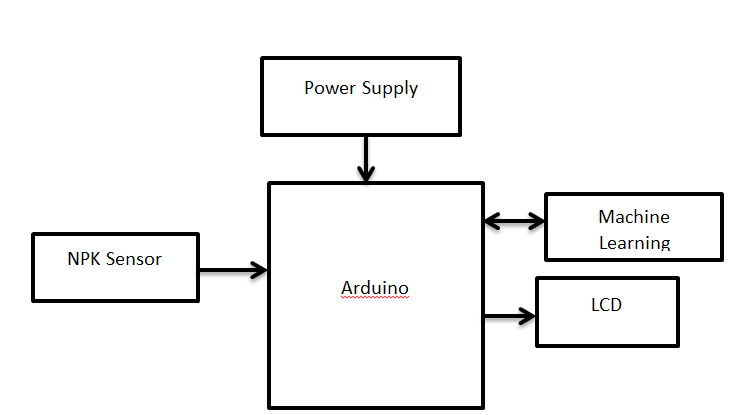
Specifications
- Hardware Requirements:
- Arduino
- NPKSensor
- LCD
- Power supply
- Software Requirements:
- Arduino IDE
- Embedded C
- python
Learning Outcomes
Learning outcomes:
- Arduino Pin diagram and Architecture
- Installation for Arduino IDE
- Basic coding in Embedded C
- Working of NPKd sensor
- How to connect NPK sensor to Arduino?
- Working of LCD
- Introduction to serial communication
- About Project Development Life Cycle:
- Planning and Requirement Gathering (software’s, Tools, Hardware components, etc.,)
- Schematic preparation
- Code development and debugging
- Hardware development and debugging
- Development of the Project and Output testing
- Practical exposure to:
- Hardware and software tools.
- Solution providing for real time problems.
- Working with team/ individual.
- Work on Creative ideas.
- Project development Skills
- Problem analyzing skills
- Problem solving skills
- Creativity and imaginary skills
- Programming skills
- Deployment
- Testing skills
- Debugging skills
- Project presentation skills
- Thesis writing skills


 Paper Publishing

Request Call Back
Would you like to receive a free callback now?
Choose the best time for callback:
Leave your message and we will contact you as soon as possible

6-2-85/B, Old Maternity Hospital Road, Thyagaraja Nagar, Tirupati, Andhra Pradesh – 517501
+91 9030333433
+91 9393939065
0877-2261612

Disclaimer - Takeoff Edu Group Projects are not associated or affiliated with IEEE in any way. The IEEE Projects mentioned here are mentioned in the context of student projects, whose ideas are derived from IEEE publications, not projects of or by IEEE.

