Federated LearningBased Skin Disease Detection with Secure Teledermatology for Privacy Preservation
Objective
The main objective of this project is to develop a secure and intelligent web-based teledermatology system that enables early detection of various skin diseases using deep learning techniques. The system aims to assist patients in uploading skin images for automated disease prediction and facilitate remote consultation with dermatologists. It integrates federated learning to ensure patient data privacy during model training and uses explainable AI to enhance prediction transparency, thereby improving diagnostic accuracy, accessibility to healthcare services, and efficient communication between patients and doctors.
Abstract
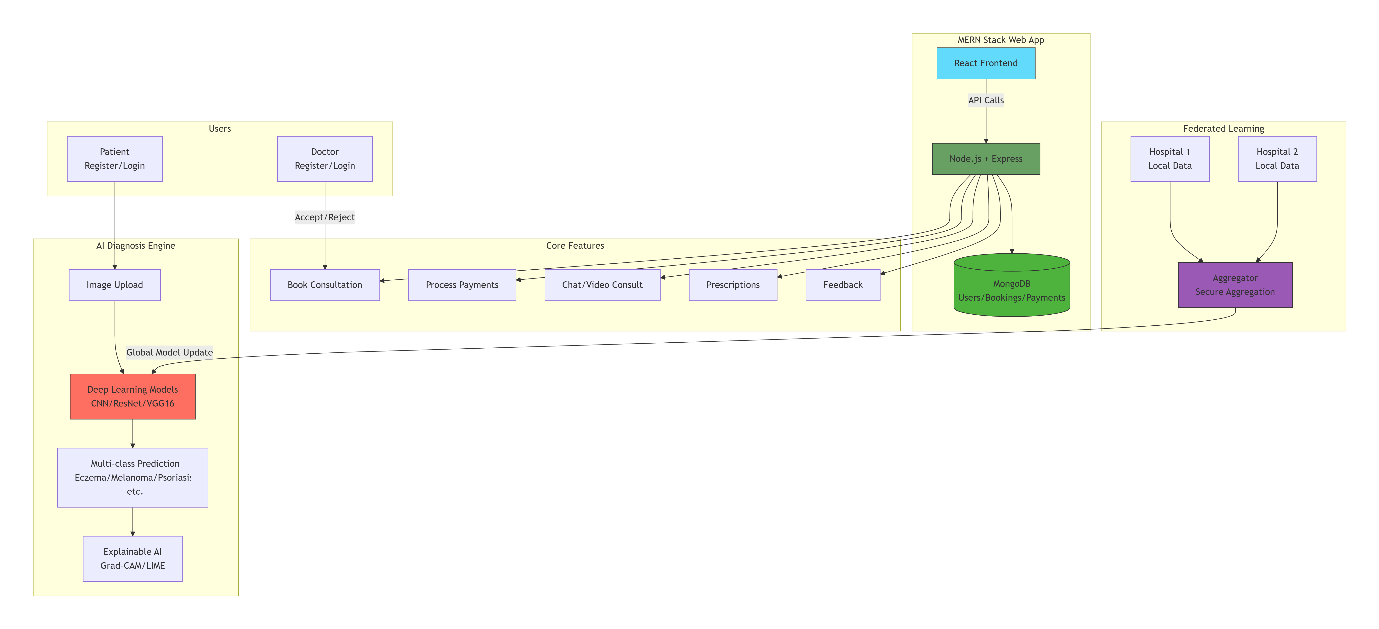
The increasing prevalence of skin diseases, including eczema, melanoma, atopic dermatitis, basal cell carcinoma, psoriatic conditions, fungal infections, and viral lesions, demands accessible, accurate, and privacy-preserving diagnostic solutions. This paper introduces a federated learning-based skin disease detection system integrated with secure teledermatology to enable remote consultations while safeguarding patient data privacy. The proposed framework employs the MERN stack (MongoDB, Express.js, React, Node.js) for a robust web application supporting two primary user roles: patients and doctors. Patients can register, log in, upload skin images for automated prediction using deep learning models, view available doctors, book consultations, track request status, process payments, engage in real-time remote consultations, note prescribed medications, and submit feedback. Doctors handle registration/login, review and accept/reject consultation requests, conduct virtual examinations, provide prescriptions, view payments and feedback, and communicate securely.
For skin disease prediction, the system leverages a multi-class classification approach trained on a comprehensive image dataset covering diverse dermatological conditions (e.g., eczema, melanoma, psoriasis, tinea, warts). Multiple convolutional neural network architectures—CNN, ResNet, and VGG16—are evaluated and trained via federated learning to enable collaborative model improvement across distributed devices/hospitals without sharing raw sensitive patient images, ensuring compliance with privacy regulations. To enhance trust and clinical interpretability, Explainable AI (XAI) techniques are incorporated to provide transparent reasoning behind predictions. This integrated approach combines accurate AI-driven preliminary diagnosis, privacy-preserving model training, and seamless teledermatology services, offering an efficient, secure, and user-centric solution for early skin disease detection and management.
Keywords: Federated Learning, Skin Disease Detection, Teledermatology, Privacy Preservation, CNN, ResNet, VGG16, Explainable AI (XAI), MERN Stack, Remote Consultation, Deep Learning, Dermatological Diagnosis, Multi-class Classification
NOTE: Without the concern of our team, please don't submit to the college. This Abstract varies based on student requirements.
Block Diagram
Specifications
SOFTWARE REQUIREMENTS:
Operating System : Windows 10/11, macOS, or Linux (Ubuntu 20.04+)
Front-End : React.js + JavaScript/TypeScript
Back-End : Node.js (v18+) + Express.js
Database : MongoDB
Key Libraries/Frameworks : React Router, Axios, Mongoose, bcryptjs, jsonwebtoken, Socket.io (real-time chat/video), Multer (uploads), Flower / TensorFlow Federated (federated learning), Captum / SHAP / LIME (XAI), Stripe/PayPal SDK (payments)
Development Tools : VS Code, Git, Postman, MongoDB Compass
Deployment : Vercel/Render (frontend), Render/Heroku/AWS/DigitalOcean (backend), PM2 + Nginx (self-hosted)
HARDWARE REQUIREMENTS:
Processor : Intel i5 / Ryzen 5 or better
RAM : 16 GB (min 8 GB)
Storage : 256 GB SSD (512 GB+ recommended)
GPU (recommended) : NVIDIA with CUDA (e.g., GTX 1650 / RTX 3060) for model training
Monitor : 15"+ Full HD
Internet : Stable 10 Mbps+ (for federated learning, video calls, uploads)


 Paper Publishing

Request Call Back
Would you like to receive a free callback now?
Choose the best time for callback:
Leave your message and we will contact you as soon as possible

6-2-85/B, Old Maternity Hospital Road, Thyagaraja Nagar, Tirupati, Andhra Pradesh – 517501
+91 9030333433
+91 9393939065
0877-2261612

Disclaimer - Takeoff Edu Group Projects are not associated or affiliated with IEEE in any way. The IEEE Projects mentioned here are mentioned in the context of student projects, whose ideas are derived from IEEE publications, not projects of or by IEEE.

