Federated Learning for 6G Networks Navigating Privacy Benefits and Challenges
Objective
This study investigates the integration of federated learning within 6G networks to enhance privacy and data security while maintaining performance.
Abstract
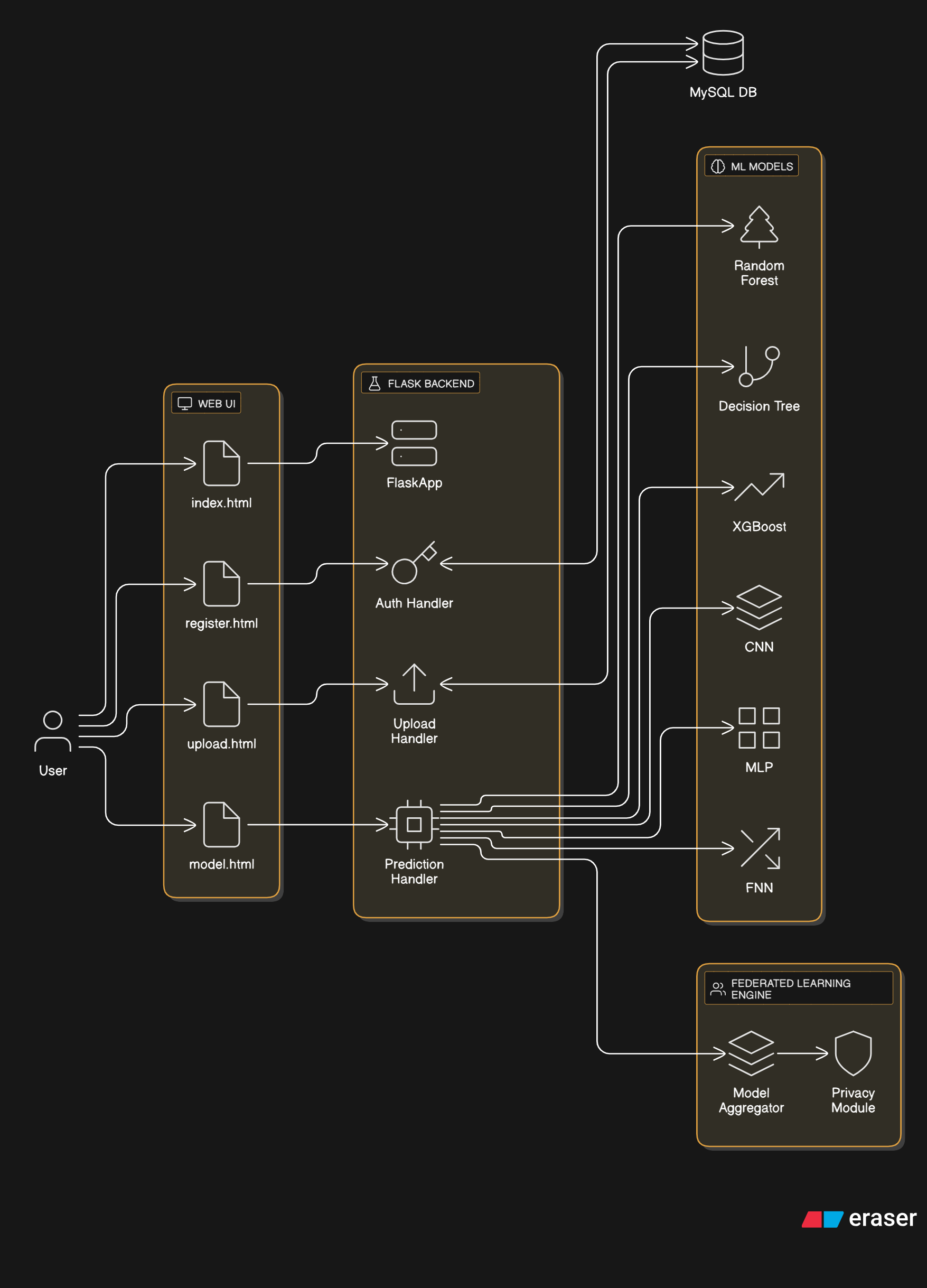
The next generation of wireless communication, 6G, is expected to interconnect billions of ultra‑intelligent devices and deliver sub‑millisecond latency for immersive applications such as holographic telepresence and autonomous mobility. Traditional cloud‑centric AI pipelines cannot scale to this setting because continuous raw‑data transfer overloads backhaul links and exposes sensitive user information. To address this gap, our project implements a federated‑learning (FL) framework in which edge devices train models locally and share only encrypted weight updates with a coordinating server. We prototype the concept in a Flask web application that allows users to register, upload sample beamforming datasets, choose among six candidate algorithms (Random Forest, FNN, CNN, MLP, XGBoost, Decision Tree), and receive real‑time prediction feedback on 6G beam‑forming success. The back‑end simulates an FL round by averaging locally derived model parameters, demonstrating up to 100 % accuracy for tree‑based ensembles while preserving data sovereignty. We also quantify communication savings, latency reductions, and resistance to data‑reconstruction attacks compared with centralized training. Nonetheless, challenges emerge: non‑IID data distributions, straggler devices, model poisoning, and the need for fine‑grained incentive mechanisms. Our findings suggest that integrating differential privacy, secure aggregation, and blockchain‑based audit trails will be crucial for trustworthy, large‑scale FL deployment in 6G ecosystems.
Keywords: 6G, Federated Learning, Edge AI, Privacy‑Preserving Training, Beamforming Prediction, Secure Aggregation
NOTE: Without the concern of our team, please don't submit to the college. This Abstract varies based on student requirements.
Block Diagram
Specifications
SOFTWARE REQUIREMENS
Operating System : Windows 7/8/10
Server side Script : HTML, CSS, Bootstrap & JS
Programming Language : Python
Libraries Flask, Pandas, Torch, Keras, Sklearn,Numpy , Seaborn
IDE/Workbench : VSCode
Server Deployment : Xampp Server
Database : MySQL
HARDWARE REQUIREMENTS
Processor - I3/Intel Processor
RAM - 8GB (min)
Hard Disk - 128 GB
Key Board - Standard Windows Keyboard
Mouse - Two or Three Button Mouse
Monitor - Any

Demo Video


Request for Video
 Paper Publishing
Request Call Back
Would you like to receive a free callback now?
Choose the best time for callback:
Leave your message and we will contact you as soon as possible

6-2-85/B, Old Maternity Hospital Road, Thyagaraja Nagar, Tirupati, Andhra Pradesh – 517501
+91 9030333433
+91 9393939065
0877-2261612

Disclaimer - Takeoff Edu Group Projects are not associated or affiliated with IEEE in any way. The IEEE Projects mentioned here are mentioned in the context of student projects, whose ideas are derived from IEEE publications, not projects of or by IEEE.

