False Data Injection Detection in Power System Based on LASSO and Ensemble Mashine learning
Objective
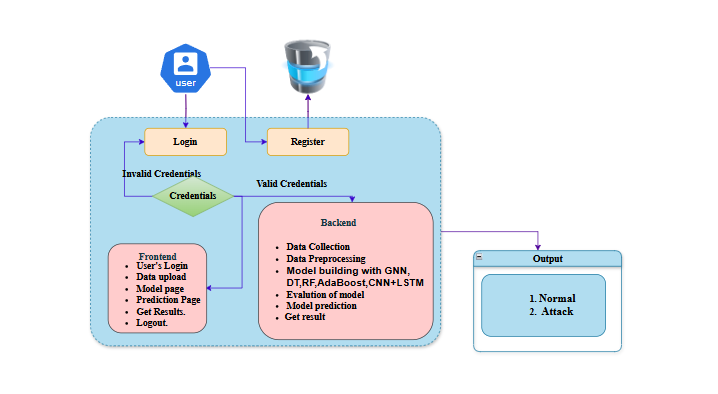
The rise of smart grids in power systems introduces vulnerabilities such as False Data Injection Attacks (FDIAs), threatening real-time data integrity. This project proposes a detection framework using LASSO for feature selection and a combination of models including Decision Tree, Random Forest, AdaBoost, CNN-LSTM, and Graph Neural Networks. To enhance interpretability, LIME is integrated for model explanation. A Flask-based web application enables user registration, data upload, prediction, and visualization. Evaluated on a Kaggle FDIA dataset, the system achieves high accuracy and low false alarm rates, offering a practical and intelligent solution for enhancing cybersecurity in modern power grid infrastructures.
Abstract
The digitization of modern power systems through smart grids has introduced new vulnerabilities, especially False Data Injection Attacks (FDIAs), which can compromise the integrity and security of real-time data. This project, titled "False Data Injection Detection in Power System Based on LASSO and Ensemble Machine Learning", presents a comprehensive detection framework that integrates LASSO regression for feature selection and a combination of machine learning and deep learning models including Decision Tree, Random Forest, AdaBoost, CNN-LSTM, and Graph Neural Networks (GNN). To enhance trust and interpretability, LIME (Local Interpretable Model-Agnostic Explanations) is incorporated, providing human-understandable insights into model decisions. A full-stack Flask web application has been developed, enabling functionalities like user registration, login, data upload, result visualization, and real-time prediction with explanations. Evaluated on a public FDIA dataset from Kaggle, the system demonstrates high accuracy, low false alarm rates, and operational transparency. The solution is designed to assist power grid operators in detecting and mitigating cyber threats effectively.
Keywords:
False Data Injection Attack, Smart Grid, LASSO Regression, Ensemble Machine
Learning, Decision Tree, Random Forest, AdaBoost, CNN-LSTM, Graph Neural
Network, Feature Selection, Lime,Cybersecurity in Power Systems, Power Grid
Monitoring.
NOTE: Without the concern of our team, please don't submit to the college. This Abstract varies based on student requirements.
Block Diagram
Specifications
SOFTWARE REQUIREMENS
Operating System : Windows 7/8/10
Server-side Script : HTML, CSS, Bootstrap & JS
Programming Language : Python
Libraries :Flask, Pandas,Tensorflow, Sklearn,Numpy , Seaborn,Torch
IDE/Workbench : VSCode
Technology : Python 3.8+
Server Deployment : Xampp Server
Database : MySQL
HARDWARE REQUIREMENTS
Processor - I3/Intel Processor
RAM - 8GB (min)
Hard Disk - 128 GB
Key Board - Standard Windows Keyboard
Mouse - Two or Three Button Mouse
Monitor - Any


 Paper Publishing

Request Call Back
Would you like to receive a free callback now?
Choose the best time for callback:
Leave your message and we will contact you as soon as possible

6-2-85/B, Old Maternity Hospital Road, Thyagaraja Nagar, Tirupati, Andhra Pradesh – 517501
+91 9030333433
+91 9393939065
0877-2261612

Disclaimer - Takeoff Edu Group Projects are not associated or affiliated with IEEE in any way. The IEEE Projects mentioned here are mentioned in the context of student projects, whose ideas are derived from IEEE publications, not projects of or by IEEE.

