Fake Reviews Detection Using Supervised Machine Learning
Objective
The primary objective of this project is to develop a machine learning-based diagnostic model utilizing ResNet and MobileNet architectures to accurately classify neuroimages into normal and stroke categories. By leveraging the advanced feature extraction capabilities of ResNet and the efficiency of MobileNet, the project aims to create a robust and efficient diagnostic tool. This model seeks to enhance the accuracy and speed of stroke diagnosis, providing clinicians with a powerful tool for early detection and timely intervention, ultimately improving patient outcomes and quality of care.
Abstract
With the continuous evolution of E-commerce systems, online reviews play a vital role in shaping consumer decisions and maintaining a business's digital reputation. Positive reviews often attract more customers, significantly boosting sales. However, the rise of deceptive or fake reviews often crafted to manipulate perception and build a false reputation poses a serious challenge. Detecting such reviews has become a critical and active area of research. While earlier approaches focused on traditional machine learning models, this paper advances the field by incorporating both classical and deep learning techniques. In addition to feature extraction and reviewer behavior analysis, we evaluate the performance of machine learning models such as K-Nearest Neighbors (KNN), Naive Bayes (NB), and Logistic Regression. Furthermore, we integrate cutting-edge transformer-based models including GPT-2, RoBERTa, XLNet, and DistilBERT for deeper contextual understanding. Experimental results on a real Yelp dataset demonstrate that transformer models significantly outperform classical models in detecting fake reviews with higher accuracy and robustness.
KEYWORDS: Machine Learning, Fake Reviews, Deep Learning, GPT-2, RoBERTa, XLNet, DistilBERT, Logistic Regression, NLP.
NOTE: Without the concern of our team, please don't submit to the college. This Abstract varies based on student requirements.
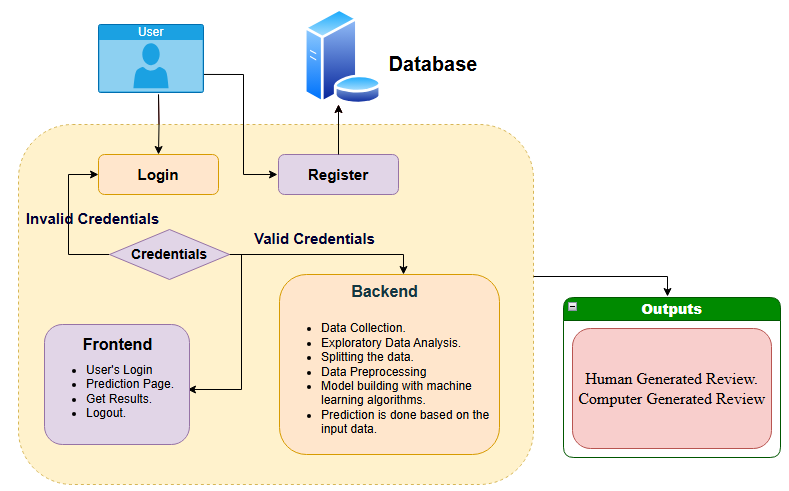
Block Diagram
Specifications
H/W SPECIFICATIONS:
· Processor - I3/Intel Processor
· RAM - 8GB (min)
· Hard Disk - 128 GB
· Key Board - Standard Windows Keyboard
· Mouse - Two or Three Button Mouse
· Monitor - Any
S/W SPECIFICATIONS:
• Operating System : Windows 10
• Server-side Script : Python 3.6
• IDE : PyCharm
• Libraries Used : Pandas, NumPy, Scikit-Learn.
• Frame Work : Django
• Data Base : MySql

Demo Video


Request for Video
 Paper Publishing
Request Call Back
Would you like to receive a free callback now?
Choose the best time for callback:
Leave your message and we will contact you as soon as possible

6-2-85/B, Old Maternity Hospital Road, Thyagaraja Nagar, Tirupati, Andhra Pradesh – 517501
+91 9030333433
+91 9393939065
0877-2261612

Disclaimer - Takeoff Edu Group Projects are not associated or affiliated with IEEE in any way. The IEEE Projects mentioned here are mentioned in the context of student projects, whose ideas are derived from IEEE publications, not projects of or by IEEE.

