Exploring the Usage of Fast Carry Chains to Implement Multistage Ring Oscillators on FPGAs: Design and Characterization
Objective
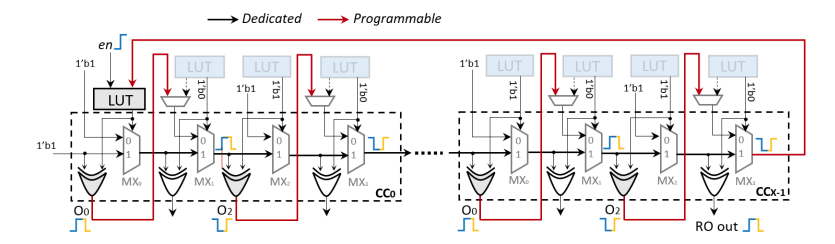
Explore the usage of fast carry chains for implementing multistage ring oscillators on FPGAs Design and characterize these oscillators
Abstract
- The project Ring oscillators (ROs) are essential in many applications, demanding high reliability, flexibility, and minimal area and energy consumption. With the rise of Internet-of-Things (IoT) technology, the efficient implementation of ROs on field-programmable gate arrays (FPGAs) has become critical, particularly for secure and resource-efficient designs. This study introduces a novel RO design strategy utilizing FPGA carry chains (CCs), significantly reducing slice usage and energy consumption by up to 50% and 44%, respectively, compared to conventional lookup table (LUT)-based designs. Implemented on an Artix-7 FPGA, the 33-stage RO achieves multiphase outputs oscillating at 29.7 MHz with a standard deviation below 10 kHz. The design also demonstrates high flexibility, allowing customization for specific applications, such as achieving a sensitivity of 49 kHz/°C—over four times higher than LUT-based counterparts—making it ideal for thermal monitoring. This approach showcases the potential of CC-based ROs for efficient and scalable FPGA implementations.
.
Keywords— Carry chains (CCs), digital circuits, field programmable gate array (FPGA), ring oscillators (ROs), temperature/voltage sensitivity analysis
NOTE: Without the concern of our team, please don't submit to the college. This Abstract varies based on student requirements.
Block Diagram
Specifications
Software Requirements:
VIVADO 2018.3
Hardware Requirements:
· Microsoft® Windows XP
· Intel® Pentium® 4 processor or Pentium 4 equivalent with SSE support
· 512 MB RAM
· 100 MB of available disk space
Learning Outcomes
- Basics of Digital Electronics
- VLSI design Flow
- Applications in real time
· VIVADO for design and simulation
· Solution providing for real time problems
· Project Development Skills:
o Problem Analysis Skills
o Problem Solving Skills
o Logical Skills
o Designing Skills
o Testing Skills
o Debugging Skills
o Presentation Skills
o Thesis Writing Skills
Demo Video


Request for Video
 Paper Publishing
Request Call Back
Would you like to receive a free callback now?
Choose the best time for callback:
Leave your message and we will contact you as soon as possible

6-2-85/B, Old Maternity Hospital Road, Thyagaraja Nagar, Tirupati, Andhra Pradesh – 517501
+91 9030333433
+91 9393939065
0877-2261612

Disclaimer - Takeoff Edu Group Projects are not associated or affiliated with IEEE in any way. The IEEE Projects mentioned here are mentioned in the context of student projects, whose ideas are derived from IEEE publications, not projects of or by IEEE.

