Exploring Deep Learning and Machine Learning Approaches for Brain Hemorrhage Detection
Objective
The objective of this project is to develop and evaluate advanced deep learning models, specifically MobileNet and ResNet, for the accurate and rapid detection of brain hemorrhages from medical images. The study aims to compare the performance of these architectures in terms of accuracy, sensitivity, specificity, and computational efficiency. By leveraging these state-of-the-art models, the project seeks to create a reliable and automated diagnostic tool that can assist healthcare professionals in making timely and precise diagnoses, thereby improving patient outcomes and reducing the time to treatment for brain hemorrhage patients.
Abstract
Brain hemorrhage, a critical medical condition requiring immediate diagnosis and treatment, poses significant challenges for accurate and timely detection. Leveraging the advancements in deep learning and machine learning, this study explores and evaluates various algorithmic approaches for brain hemorrhage detection, with a particular focus on MobileNet and ResNet architectures. These state-of-the-art convolutional neural networks (CNNs) are known for their efficiency and high performance in image classification tasks.
MobileNet, designed for lightweight applications, offers a streamlined architecture suitable for deployment in resource-constrained environments such as mobile devices. ResNet, on the other hand, is recognized for its deep residual learning capabilities, enabling the training of extremely deep networks without the common pitfalls of vanishing gradients.
This research involves the application and comparative analysis of these two architectures on a dataset of brain hemorrhage images. By assessing their accuracy, sensitivity, and specificity, we aim to identify the strengths and limitations of each approach. The outcomes of this study are expected to provide valuable insights into the practical applications of MobileNet and ResNet for medical image analysis, ultimately contributing to improved diagnostic tools and patient outcomes in the clinical setting.
Keywords: Brain hemorrhage detection, deep learning, machine learning, MobileNet, ResNet, convolutional neural networks, medical image analysis, diagnostic tools, healthcare.
NOTE: Without the concern of our team, please don't submit to the college. This Abstract varies based on student requirements.
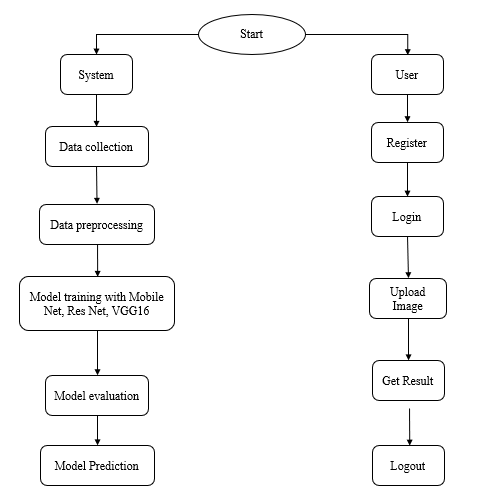
Block Diagram
Specifications
Hardware Requirements
Processor - I3/Intel Processor
Hard Disk - 160GB
Key Board - Standard Windows Keyboard
Mouse - Two or Three Button Mouse
Monitor - SVGA
RAM - 8GB
Software Requirements:
Operating System : Windows 7/8/10/11
Server side Script : HTML, CSS, Bootstrap & JS
Programming Language : Python
Libraries : Flask, Pandas, Mysql.connector, Os, Smtplib, Numpy
IDE/Workbench : PyCharm or VS Code
Technology : Python 3.6+
Server Deployment : Xampp Server
Database : MySQL

Demo Video


Request for Video
 Paper Publishing
Request Call Back
Would you like to receive a free callback now?
Choose the best time for callback:
Leave your message and we will contact you as soon as possible

6-2-85/B, Old Maternity Hospital Road, Thyagaraja Nagar, Tirupati, Andhra Pradesh – 517501
+91 9030333433
+91 9393939065
0877-2261612

Disclaimer - Takeoff Edu Group Projects are not associated or affiliated with IEEE in any way. The IEEE Projects mentioned here are mentioned in the context of student projects, whose ideas are derived from IEEE publications, not projects of or by IEEE.

