Evaluating the Differences Between Sequential and Combinational Logic Circuit Designs
Objective
1. To understand the fundamental concepts of combinational and sequential logic circuits, including their operational principles and timing behaviors. 2. To design representative combinational circuits (e.g., adders, multiplexers, decoders) and sequential circuits (e.g., flip-flops, counters, shift registers) for comparison.
Abstract
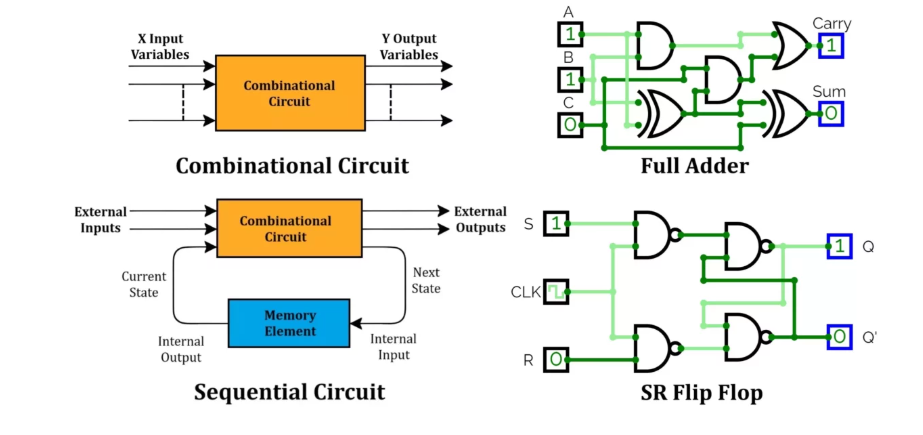
Digital circuits form the backbone of modern computing systems, and understanding their design methodologies is crucial for efficient hardware implementation. Logic circuits can be broadly categorized into combinational and sequential circuits. Combinational circuits produce outputs solely based on current inputs, whereas sequential circuits consider both current inputs and past states. This study evaluates the fundamental differences between these two circuit types and explores their implications in high-performance digital systems. Special emphasis is given to the design of a low-latency floating-point multiplier using parallel prefix adders, which significantly improves speed and power efficiency by reducing critical path delay. The work highlights how leveraging combinational structures like parallel prefix adders in sequential multiplier architectures can optimize performance in floating-point computations..
NOTE: Without the concern of our team, please don't submit to the college. This Abstract varies based on student requirements.
Block Diagram
Specifications
Software Requirements
- Xilinx Vivado Design Suite (2020.2 or later)
- Verilog HDL for RTL design and implementation
- Vivado Simulator (XSIM) for functional and timing verification
- MATLAB (optional) for GPR data preprocessing, noise modeling, and result validation
Hardware Requirements
- Microsoft® Windows 10 / Windows 11 (64-bit)
- Intel® Core™ i5 / i7 Processor or equivalent
- Minimum 8 GB RAM
- Minimum 500 MB free disk space
Learning Outcomes
Understand the key differences between combinational and sequential logic circuits.
Learn how parallel prefix adders improve adder performance in multiplier designs.
Gain insights into hybrid architectures combining sequential control and combinational speed.
Develop skills to optimize digital circuits for latency, power, and area trade-offs.
Appreciate the practical applications of low-latency floating-point multipliers in real-world systems.


 Paper Publishing

Request Call Back
Would you like to receive a free callback now?
Choose the best time for callback:
Leave your message and we will contact you as soon as possible

6-2-85/B, Old Maternity Hospital Road, Thyagaraja Nagar, Tirupati, Andhra Pradesh – 517501
+91 9030333433
+91 9393939065
0877-2261612

Disclaimer - Takeoff Edu Group Projects are not associated or affiliated with IEEE in any way. The IEEE Projects mentioned here are mentioned in the context of student projects, whose ideas are derived from IEEE publications, not projects of or by IEEE.

