ESP32-Based Smart Air Purifier with Real-Time Pollution Data Upload
Objective
ESP32-Based Smart Air Purifier with Real-Time Pollution Data Upload that monitors air quality using sensors and automatically adjusts the purifier’s operation based on pollution levels. It uses the ESP32 for real-time control and IoT connectivity to upload data to the cloud. The project focuses on creating a prototype that ensures intelligent air purification, energy efficiency, and remote monitoring.
Abstract
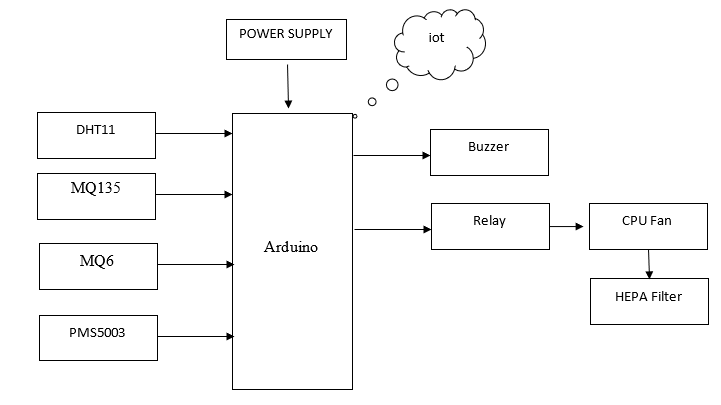
The ESP32-Based Smart Air Purifier with Real-Time Pollution Data Upload is an intelligent air quality monitoring and purification system designed to improve indoor environmental conditions. The system uses an ESP32 microcontroller as the main controller and continuously monitors air quality using MQ135, MQ6, and PMS5003 sensors. A DHT11 sensor measures temperature and humidity levels, while an LCD displays real-time environmental data and air quality status. The collected sensor data is uploaded to an IoT cloud platform for remote monitoring and analysis. When air pollution levels exceed predefined thresholds, the ESP32 automatically activates a relay connected to a HEPA filter and CPU fan, which purify the surrounding air by removing harmful gases and particulate matter. A buzzer generates alerts whenever poor air quality conditions are detected. The proposed system provides automated air purification, real-time monitoring, and remote accessibility, making it suitable for homes, offices, hospitals, and smart buildings.
NOTE: Without the concern of our team, please don't submit to the college. This Abstract varies based on student requirements.
Block Diagram
Specifications
Hardware components:
- ESP32
- Arduino LCD Display
- MQ135 Gas Sensor
- MQ6 Gas Sensor
- PMS5003 Dust Sensor
- DHT11 Sensor
- Relay Module
- HEPA Filter
- CPU Fan
- Buzzer
- USB Cable
- Power Supply
- 12V Adapter
- Connectors – 30
Software components:
- Embedded C
- Arduino IDE
Learning Outcomes
· Understanding ESP32 pin diagram and architecture
· Installing and configuring Arduino IDE for ESP32
· Setting up sensors and IoT platforms for autonomous robots
· Introduction to programming and control using Arduino IDE
· Basic coding for motor and sensor integration
· Working with ultrasonic sensors and IP camera for navigation
· Interfacing motor drivers and DC motors with ESP32
· Implementing IoT-based monitoring and remote control
· Understanding power management for mobile robotic systems
· About Project Development Life Cycle:
o Planning and Requirement Gathering (software’s, Tools, Hardware components, etc.,)
o Schematic preparation
o Code development and debugging
o Hardware development and debugging
o Development of the Project and Output testing
· Practical exposure to:
o Hardware and software tools.
o Solution providing for real time problems.
o Working with team/ individual.
o Work on Creative ideas.
· Project development Skills:
o Problem analyzing skills
o Problem solving skills
o Creativity and imaginary skills
o Programming skills
o Deployment
o Testing skills
o Debugging skills
o Project presentation skills
o Thesis writing skills
Demo Video


Request for Video
 Paper Publishing
Request Call Back
Would you like to receive a free callback now?
Choose the best time for callback:
Leave your message and we will contact you as soon as possible

6-2-85/B, Old Maternity Hospital Road, Thyagaraja Nagar, Tirupati, Andhra Pradesh – 517501
+91 9030333433
+91 9393939065
0877-2261612

Disclaimer - Takeoff Edu Group Projects are not associated or affiliated with IEEE in any way. The IEEE Projects mentioned here are mentioned in the context of student projects, whose ideas are derived from IEEE publications, not projects of or by IEEE.

