ER-TCAM: A Soft-Error-Resilient SRAM-Based Ternary Content-Addressable Memory for FPGAs
Also Available Domains Communications|Xilinx Vivado|Xilinx ISE
Objective
The main theme of this work is to protect the memories against soft errors by reducing the minimal path delay. This technique uses a single-bit parity for fault detection & the binary-encoded TCAM table maintained in SRAM-based TCAMs for update purposes.
Abstract
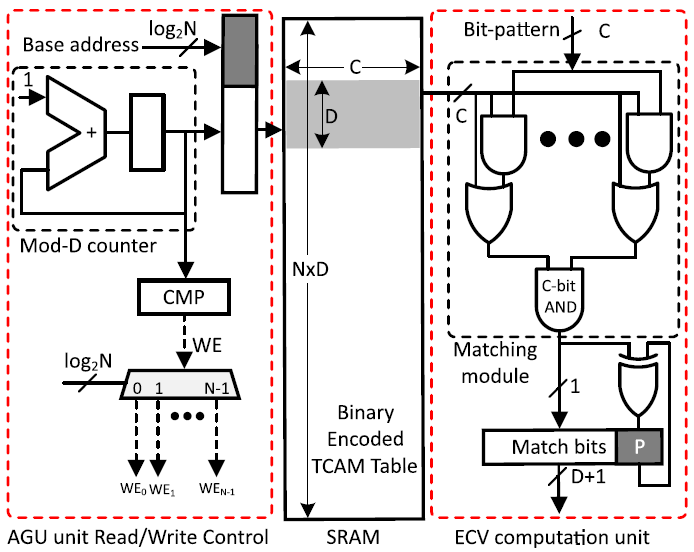
In this project, a low-cost, low-response time and easy for integration technique for the protection of SRAM-enabled TCAMs without compromising the search performance is presented. The error detection is carried out in a simple way using single-bit parity checking at a minimal delay and logic overhead. The proposed error-correction technique exploits the redundant binary-encoded TCAM table maintained in SRAM-based TCAM solutions for update purposes to correct soft errors. It maintains a high search performance while the proposed error correction mechanism is carried out in the background, allowing search operations to be performed simultaneously. The proposed error-correction technique has a low response time, ensuring a faultless TCAM design for lookups, during the entire processing time.
Keywords: Field Programmable Gate Array (FPGA), soft errors, Static Random Access Memory (SRAM), Ternary Content Addressable Memory (TCAM)
NOTE: Without the concern of our team, please don't submit to the college. This Abstract varies based on student requirements.
Block Diagram
Specifications
Software Requirements:
- Xilinx Vivado
- HDL: Verilog
Hardware Requirements:
- Microsoft® Windows XP
- Intel® Pentium® 4 processor or Pentium 4 equivalent with SSE support
- 512 MB RAM
- 100 MB of available disk space


 Paper Publishing

Request Call Back
Would you like to receive a free callback now?
Choose the best time for callback:
Leave your message and we will contact you as soon as possible

6-2-85/B, Old Maternity Hospital Road, Thyagaraja Nagar, Tirupati, Andhra Pradesh – 517501
+91 9030333433
+91 9393939065
0877-2261612

Disclaimer - Takeoff Edu Group Projects are not associated or affiliated with IEEE in any way. The IEEE Projects mentioned here are mentioned in the context of student projects, whose ideas are derived from IEEE publications, not projects of or by IEEE.

