Ensemble Machine Learning Approaches for Fault Detection in Optical Fiber Networks
Objective
The objective of this project is to develop an automated fault detection system for optical fiber networks using ensemble machine learning techniques. The system aims to improve fault detection accuracy by leveraging models such as Stacking Classifier, Voting Classifier, and Random Forest, which combine multiple machine learning algorithms to enhance prediction performance. The project focuses on preprocessing a dataset containing network features such as signal strength, temperature, and attenuation, ensuring the data is clean and ready for model training. By evaluating the performance of these models using classification metrics like accuracy, precision, recall, and F1-score, the system will determine the most effective approach for fault detection. Additionally, the project includes the development of a user-friendly interface that allows users to easily interact with the system, upload data, and view the results. Ultimately, the goal is to provide a reliable, scalable solution for detecting faults in optical fiber networks, enhancing network maintenance and performance.
Abstract
The increasing reliance on optical fiber networks for high-speed internet and telecommunication services requires effective fault detection systems to ensure optimal performance and minimize downtime. This research presents a machine learning-based approach for fault detection in optical fiber networks using ensemble methods. The system utilizes three ensemble classifiers: Stacking Classifier, Voting Classifier, and Random Forest. These models are designed to combine multiple machine learning algorithms, including Random Forest (RF), LightGBM, and Adaboost, to improve detection accuracy. The project employs a dataset from Kaggle, which includes network features such as temperature, signal strength, and attenuation, to train the models. The system is developed with a user-friendly interface using HTML, CSS, and JavaScript for the front-end, and Flask with Python for the back-end. The primary goal of this project is to enhance the reliability and performance of optical fiber networks by providing a robust fault detection mechanism. Evaluation metrics like accuracy, precision, recall, and F1-score are used to assess the effectiveness of the models. The results show that ensemble techniques significantly improve fault detection compared to individual models, making this approach a valuable tool for network monitoring and maintenance.
Keywords: Optical Fiber Networks, Fault Detection, Ensemble Machine Learning, Stacking Classifier, Voting Classifier, Random Forest, Performance Evaluation.
NOTE: Without the concern of our team, please don't submit to the college. This Abstract varies based on student requirements.
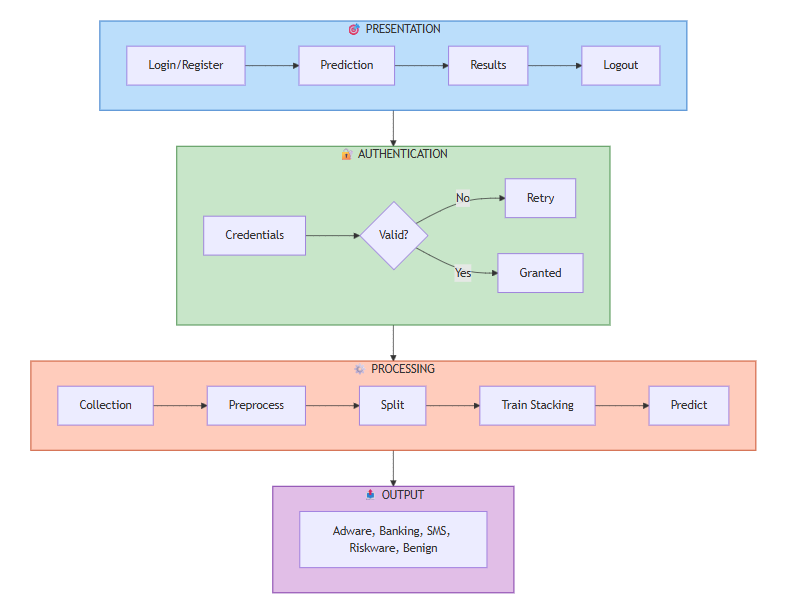
Block Diagram
Specifications
Hardware Requirements
Processor - I3/Intel Processor
Hard Disk - 160GB
Key Board - Standard Windows Keyboard
Mouse - Two or Three Button Mouse
Monitor - SVGA
RAM - 8GB
Software Requirements:
Operating System : Windows 7/8/10
Server side Script : HTML, CSS, Bootstrap & JS
Programming Language : Python
Libraries : Flask/Django, Pandas, Mysql.connector, Os, Smtplib, Numpy
IDE/Workbench : PyCharm
Technology : Python 3.6+
Server Deployment : Xampp Server
Database : MySQL


 Paper Publishing

Request Call Back
Would you like to receive a free callback now?
Choose the best time for callback:
Leave your message and we will contact you as soon as possible

6-2-85/B, Old Maternity Hospital Road, Thyagaraja Nagar, Tirupati, Andhra Pradesh – 517501
+91 9030333433
+91 9393939065
0877-2261612

Disclaimer - Takeoff Edu Group Projects are not associated or affiliated with IEEE in any way. The IEEE Projects mentioned here are mentioned in the context of student projects, whose ideas are derived from IEEE publications, not projects of or by IEEE.

