Enhancing Victim Detection In Disaster Scenarios A Yolov7 And Yolov8 Performance Study
Objective
The objective of this project is to develop an advanced victim detection system for rapid response in disaster scenarios, such as earthquakes, where timely identification of survivors is critical for saving lives. By leveraging state-of-the-art object detection models, YOLOv7 and YOLOv8, the project aims to evaluate their effectiveness in recognizing human bodies amidst debris and challenging post-disaster environments. The study focuses on comparing the models’ accuracy, precision, recall, and real-time performance to identify the most efficient approach. Ultimately, the goal is to enhance disaster response capabilities through improved detection accuracy, enabling faster and more reliable rescue operations.
Abstract
In the aftermath of natural disasters like earthquakes, rapid identification of victims is vital for efficient rescue operations. The ability to locate victims accurately and quickly amidst debris and challenging conditions can make a critical difference in saving lives. This study evaluates the performance of two advanced object detection models, YOLOv7 and YOLOv8, for victim detection in disaster scenarios. Both models were trained on a specialized dataset that simulates post-disaster environments, incorporating diverse and realistic challenges such as occlusions, varying lighting conditions, and complex backgrounds.
The experimental results demonstrated an accuracy of 58% for YOLOv7 and a significantly improved accuracy of 81% for YOLOv8, showcasing the latter's superior capability in detecting human bodies among debris. Additionally, YOLOv8 outperformed YOLOv7 in terms of precision, recall, and detection speed, making it better suited for real-time applications. YOLOv7, while less accurate, demonstrated a faster inference time, which could be advantageous in scenarios requiring rapid initial assessments.
This comparative analysis not only highlights the advancements of YOLOv8 but also sheds light on the strengths and limitations of YOLOv7, particularly in handling occluded objects and detecting victims in cluttered environments. The findings underscore the potential of leveraging YOLOv8 in real-time disaster response systems, where quick and reliable victim identification is crucial. Future work could focus on enhancing the robustness of these models by incorporating data from diverse disaster scenarios, integrating additional sensor modalities such as infrared imaging or thermal cameras, and further optimizing model architectures to balance speed and accuracy.
These advancements can pave the way for more effective deployment of AI-powered tools in emergency rescue operations, improving outcomes and saving more lives during critical times.
Keywords: victim detection, disaster response, YOLOv7, YOLOv8, emergency rescue, deep learning models, accuracy comparison, real-time detection, precision, recall, robustness.
NOTE: Without the concern of our team, please don't submit to the college. This Abstract varies based on student requirements.
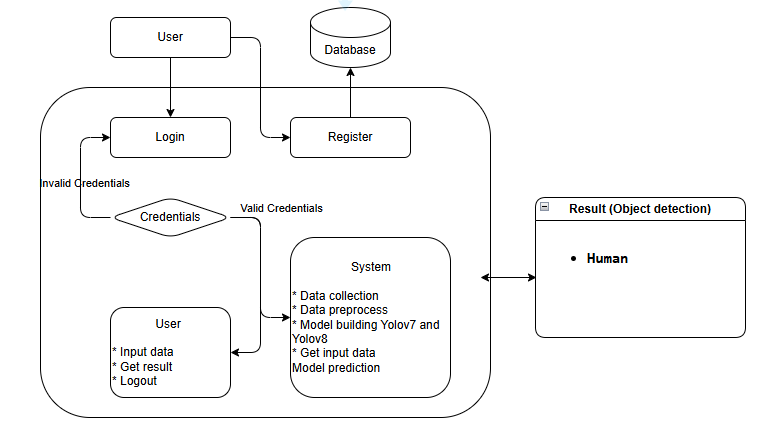
Block Diagram
Specifications
SOFTWARE REQUIREMENS
Operating System : Windows 7/8/10
Server side Script : HTML, CSS, Bootstrap & JS
Programming Language : Python
Libraries :Flask, Torch, Tensorflow, Pandas, Mysql.connector
IDE/Workbench : VSCode
Server Deployment : Xampp Server
Database : MySQL
HARDWARE REQUIREMENTS
Processor I3/Intel Processor
RAM 8GB (min)
Hard Disk 128 GB
Key Board Standard Windows Keyboard
Mouse Two or Three Button Mouse
Monitor Any

Demo Video


Request for Video
 Paper Publishing
Request Call Back
Would you like to receive a free callback now?
Choose the best time for callback:
Leave your message and we will contact you as soon as possible

6-2-85/B, Old Maternity Hospital Road, Thyagaraja Nagar, Tirupati, Andhra Pradesh – 517501
+91 9030333433
+91 9393939065
0877-2261612

Disclaimer - Takeoff Edu Group Projects are not associated or affiliated with IEEE in any way. The IEEE Projects mentioned here are mentioned in the context of student projects, whose ideas are derived from IEEE publications, not projects of or by IEEE.

