Enhancing Structural Health Monitoring Systems Using Integrated Fog and Cloud Computing within an IoT Framework
Objective
To optimize the performance and reliability of structural health monitoring systems by integrating fog and cloud computing within an IoT framework, enhancing real-time data analysis, and improving asset management and maintenance efficiency.
Abstract
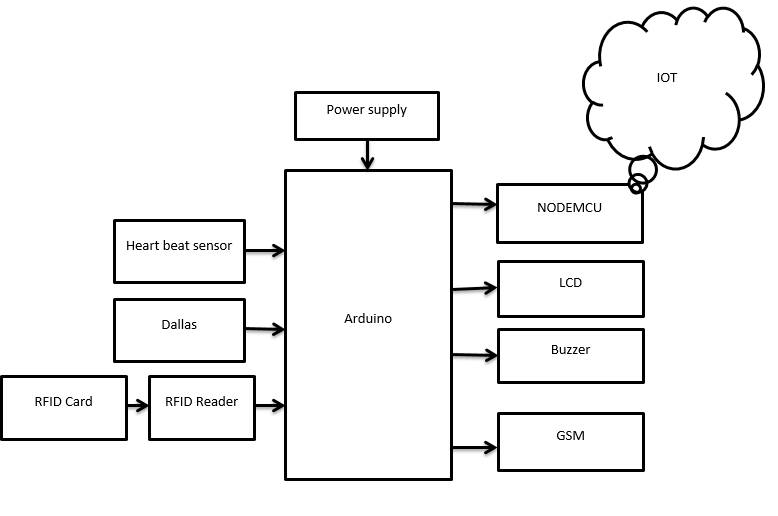
This project aims to optimize structural health monitoring systems by integrating fog and cloud computing within an Internet of Things (IoT) framework. The system employs a diverse array of sensors and devices, including Arduino-based heartbeat sensors for detecting vibrations, Dallas temperature sensors for monitoring thermal conditions, RFID card readers for asset tracking, and an LCD display for real-time status updates. These sensors continuously gather data on the structural integrity and environmental conditions of critical components.The data collected is transmitted through a NodeMCU microcontroller to the ThingSpeak IoT webserver for centralized analysis and visualization. The integration of fog computing allows for local processing of data at the network edge, reducing latency and bandwidth usage, while cloud computing provides scalable storage and advanced analytics capabilities. This hybrid approach facilitates both immediate and long-term insights into structural health.The system is engineered to automatically generate alerts via GSM messaging when any health metric, such as temperature or vibration levels, exceeds predefined thresholds. This feature ensures timely intervention, minimizing potential damage and enhancing maintenance efficiency. The incorporation of RFID technology further refines asset management and monitoring precision.Overall, the project seeks to improve the reliability and scalability of structural health monitoring by combining local and cloud-based computing resources. The use of NodeMCU for data transmission to the IoT webserver supports a robust, responsive, and scalable solution for proactive infrastructure management.
NOTE: Without the concern of our team, please don't submit to the college. This Abstract varies based on student requirements.
Block Diagram
Specifications
Hardware Requirements:
- Arduino
- Dallas
- Heart Beat sensor
- LCD
- NODEMCU
- GSM
- Power supply
- RFID Module
- Buzzer
Software Requirements:
- Arduino IDE
- Embedded C
Learning Outcomes
- Arduino diagram and Architecture
- Installation for Arduino IDE
- Basic coding in Arduino
- Working of Heartbeat sensor
- How to connect Dallas sensor to Arduino?
- Working of LCD
- Working of GSM ?
- How to connect LCD to Arduinoi?
- Introduction to serial communication
- About Project Development Life Cycle:
- Planning and Requirement Gathering (software’s, Tools, Hardware components, etc.,)
- Schematic preparation
- Code development and debugging
- Hardware development and debugging
- Development of the Project and Output testing
- Practical exposure to:
- Hardware and software tools.
- Solution providing for real time problems.
- Working with team/ individual.
- Work on Creative ideas.
- Project development Skills
- Problem analyzing skills
- Problem solving skills
- Creativity and imaginary skills
- Programming skills
- Deployment
- Testing skills
- Debugging skills
- Project presentation skills
- Thesis writing skills


 Paper Publishing

Request Call Back
Would you like to receive a free callback now?
Choose the best time for callback:
Leave your message and we will contact you as soon as possible

6-2-85/B, Old Maternity Hospital Road, Thyagaraja Nagar, Tirupati, Andhra Pradesh – 517501
+91 9030333433
+91 9393939065
0877-2261612

Disclaimer - Takeoff Edu Group Projects are not associated or affiliated with IEEE in any way. The IEEE Projects mentioned here are mentioned in the context of student projects, whose ideas are derived from IEEE publications, not projects of or by IEEE.

