Enhancing Strabismus Diagnosis from Detection to Classification with Deep Learning
Objective
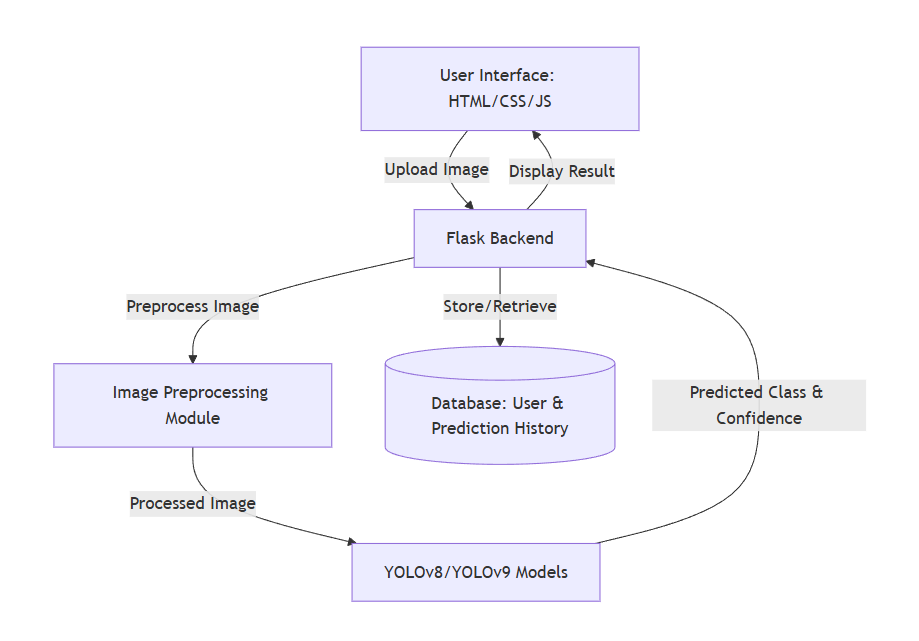
This project aims to build an automated system that can detect and classify strabismus using deep-learning models. It combines YOLOv8 and YOLOv9 to first locate the eye region and then identify alignment conditions. A simple web interface allows users to register, log in, upload images, and view their prediction history easily. The system also stores results with timestamps for better tracking. The workflow is optimized for fast and accurate performance while maintaining stability through a clean Flask-based backend. Overall, the goal is to create a reliable, user-friendly diagnostic assistant for strabismus detection and classification.
Abstract
This project focuses on improving strabismus diagnosis by integrating detection and classification in a single deep learning pipeline. Strabismus is a condition in which the eyes fail to align properly, leading to visual imbalance. Traditional assessment depends on manual observation, which can be slow and inconsistent. The goal of this project is to create a structured, automated system that supports faster, clearer, and more reliable identification of eye misalignment.
The project uses a dataset containing labeled eye images and applies two modern object-detection models, YOLOv8 and YOLOv9, to build a complete diagnostic workflow. The system begins by detecting eye regions and then classifying them into normal or various forms of strabismus. A Flask-based backend manages model processing, while the interface is created using HTML, CSS, and JavaScript. Users can register, log in, upload images, and access prediction history through a simple and organized interface.
The design emphasizes efficiency, readable output, and structured analysis. By combining detection with classification, the system reduces dependency on manual inspection and provides consistent results. Features such as user authentication, prediction tracking, and integrated model usage create a complete diagnostic assistant.
This project demonstrates how optimized deep learning methods and simple web technologies can work together to support better screening and analysis of strabismus, offering an accessible and repeatable approach to automated eye-alignment evaluation.
Keywords: strabismus, deep learning, YOLOv8, YOLOv9, detection, classification, eye alignment, computer vision, Flask, automation.
NOTE: Without the concern of our team, please don't submit to the college. This Abstract varies based on student requirements.
Block Diagram
Specifications
Hardware Requirements
Processor - I3/Intel Processor
Hard Disk - 160GB
Key Board - Standard Windows Keyboard
Mouse - Two or Three Button Mouse
Monitor - SVGA
RAM - 8GB
Software Requirements
Operating System : Windows 7/8/10
Programming Language : Python
Libraries : Pandas, Numpy, scikit-learn.
IDE/Workbench : Visual Studio Code.
Framework : Flask

Demo Video


Request for Video
 Paper Publishing
Request Call Back
Would you like to receive a free callback now?
Choose the best time for callback:
Leave your message and we will contact you as soon as possible

6-2-85/B, Old Maternity Hospital Road, Thyagaraja Nagar, Tirupati, Andhra Pradesh – 517501
+91 9030333433
+91 9393939065
0877-2261612

Disclaimer - Takeoff Edu Group Projects are not associated or affiliated with IEEE in any way. The IEEE Projects mentioned here are mentioned in the context of student projects, whose ideas are derived from IEEE publications, not projects of or by IEEE.

