Enhancing Short-Term Wind Speed Prediction Based on Deep Learning With Ensemble Learning Model for Small Wind Turbine Applications
Objective
The project focuses on enhancing short-term wind speed prediction for small wind turbine applications, which is crucial for optimizing wind energy production. By integrating deep learning techniques with ensemble learning models, the system aims to provide accurate and reliable predictions of wind speed, leveraging a combination of machine learning algorithms, including XGBoost, MLP, and LSTM. The model utilizes nine key meteorological features, such as air temperature, wind speed, and turbulence intensity, to make precise forecasts. Built with a Flask backend, the system integrates a trained XGBoost model to facilitate real-time predictions, allowing users to upload CSV data for analysis, register and log in for secure access, and view the feasibility of wind energy generation based on predicted wind conditions. The accuracy of the model is rigorously evaluated, showcasing its exceptional performance in forecasting wind speed. This tool serves as a valuable decision-making aid for the renewable energy sector, particularly in optimizing energy production from small-scale wind turbines. By combining advanced deep learning with ensemble models, the project improves the reliability and robustness of wind speed forecasting, contributing to more efficient and sustainable energy generation.
Abstract
The short-term wind speed prediction is critical for efficient wind energy production, particularly in small wind turbine applications. This study presents an enhanced prediction model based on deep learning integrated with an ensemble learning approach. The system employs a combination of machine learning algorithms, including XGBoost, MLP, and LSTM, to predict wind speed and assess the feasibility of wind energy generation. The model leverages nine key meteorological features, such as air temperature, wind speed, and turbulence intensity, to provide highly accurate predictions. The backend of the system is built with Flask, which integrates a trained XGBoost model for real-time predictions. The system allows users to upload CSV data for analysis, register and log in to access the model’s functionalities, and view the feasibility of wind energy production. Additionally, the model's accuracy is evaluated, demonstrating exceptional performance in wind speed prediction. This tool provides significant support for decision-making in the renewable energy sector, especially for small-scale wind turbine installations, ensuring efficient use of resources and optimizing energy output. By leveraging advanced deep learning techniques combined with ensemble learning models, this research enhances the reliability and robustness of wind speed forecasting for sustainable energy production.
Keywords:
Short-term wind speed prediction, deep learning, ensemble learning, XGBoost, MLP, LSTM, wind energy feasibility, small wind turbines, renewable energy, Flask.
NOTE: Without the concern of our team, please don't submit to the college. This Abstract varies based on student requirements.
Block Diagram
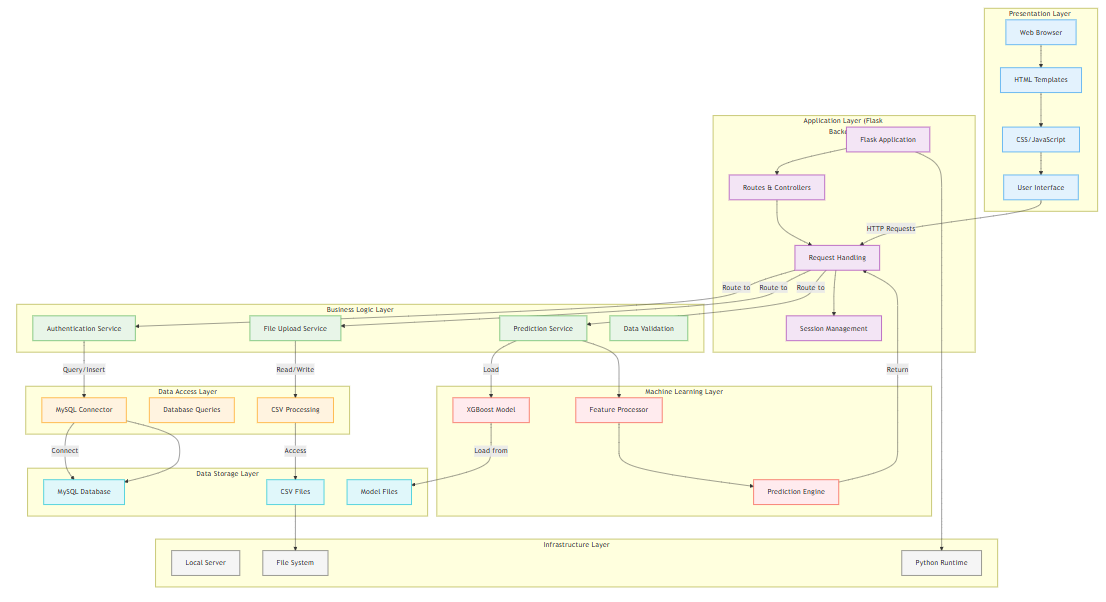
Specifications
SOFTWARE REQUIREMENS
Operating System : Windows 7/8/10
Server side Script : HTML, CSS, Bootstrap & JS
Programming Language : Python
Libraries : Flask, Pandas, Torch, Keras, Sklearn, Numpy , Seaborn
IDE/Workbench : VSCODE
Server Deployment : Xampp Server
Database : MySQL
HARDWARE REQUIREMENTS
Processor - I3/Intel Processor
RAM - 8GB (min)
Hard Disk - 128 GB
Key Board - Standard Windows Keyboard
Mouse - Two or Three Button Mouse
Monitor - Any


 Paper Publishing

Request Call Back
Would you like to receive a free callback now?
Choose the best time for callback:
Leave your message and we will contact you as soon as possible

6-2-85/B, Old Maternity Hospital Road, Thyagaraja Nagar, Tirupati, Andhra Pradesh – 517501
+91 9030333433
+91 9393939065
0877-2261612

Disclaimer - Takeoff Edu Group Projects are not associated or affiliated with IEEE in any way. The IEEE Projects mentioned here are mentioned in the context of student projects, whose ideas are derived from IEEE publications, not projects of or by IEEE.

