Enhancing Phishing Detection A Machine Learning Approach with Feature Selection and Deep Learning Models
Objective
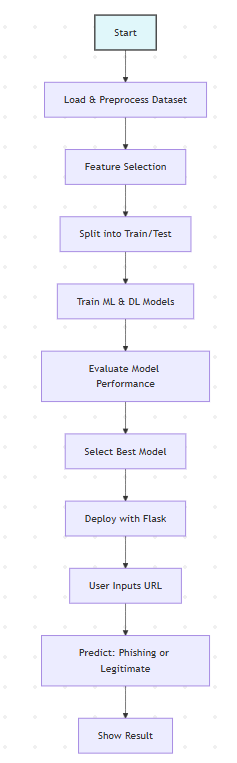
The primary objective of this project is to design and implement a robust phishing detection framework that uses advanced machine learning and deep learning models to distinguish between legitimate and phishing websites. The key goals are preprocess and clean the dataset containing labeled website features and apply feature selection techniques for reducing dimensionality and improving model performance.develop and compare the effectiveness of various models, including GCN, TabTransformer, Autoencoder, FNN, and DNN
Abstract
Phishing attacks have evolved as a major cybersecurity threat, exploiting user trust and compromising sensitive information. This study proposes an advanced phishing detection framework combining feature selection techniques with machine learning and deep learning models. Using a labeled dataset with the status field indicating legitimate or phishing websites, we evaluate and compare the performance of various models including Graph Convolutional Network (GCN), TabTransformer, Autoencoder, Feedforward Neural Network (FNN), and Deep Neural Network (DNN). By applying optimal feature selection, we enhance model performance, reduce computational complexity, and improve generalization. The system is implemented using Python and deployed with a Flask web interface styled with HTML and CSS, ensuring user-friendly interaction. Our results demonstrate that the integration of deep learning architectures with feature engineering significantly boosts phishing detection accuracy and robustness. This approach offers a scalable and effective solution to safeguard users against phishing threats in real-world applications.
Keywords: Phishing Detection, Feature Selection, GCN, TabTransformer, Autoencoder, FNN, DNN, Flask, Cybersecurity.
NOTE: Without the concern of our team, please don't submit to the college. This Abstract varies based on student requirements.
Block Diagram
Specifications
H/W CONFIGURATION:
Hard Disk -160 GB
Processor - I3/Intel Processor
RAM - 8 GB
S/W CONFIGURATION:
Operating System : Windows 7/8/10 .
Server-side Script : HTML, CSS & JS.
IDE : Vscode
Libraries Used : Numpy, Pandas,Sklearn,Tensorflow
Franework : Flask
Technology : Python 3.6+.

Demo Video


Request for Video
 Paper Publishing
Request Call Back
Would you like to receive a free callback now?
Choose the best time for callback:
Leave your message and we will contact you as soon as possible

6-2-85/B, Old Maternity Hospital Road, Thyagaraja Nagar, Tirupati, Andhra Pradesh – 517501
+91 9030333433
+91 9393939065
0877-2261612

Disclaimer - Takeoff Edu Group Projects are not associated or affiliated with IEEE in any way. The IEEE Projects mentioned here are mentioned in the context of student projects, whose ideas are derived from IEEE publications, not projects of or by IEEE.

