Enhancing Hybrid Classification for Plant Diseases With Deep Feature Selection Based on Analytical Entropy and Statistical Method
Objective
Ovarian cancer prediction remains a critical challenge in medical diagnosis. This project aims to enhance ovarian cancer prediction by utilizing multiple machine learning algorithms, including Decision Tree, Random Forest, LightGBM, XGBoost, CNN, and GRU. The dataset used is from Kaggle, containing medical features essential for ovarian cancer detection. By applying Gaussian metrics for data balancing and RobustScaler for feature scaling, the project optimizes the model’s performance. The system performs binary classification to predict the likelihood of ovarian cancer. The backend is built using Flask, while the front-end leverages HTML, CSS, and JavaScript for ease of use. This approach improves prediction accuracy and scalability, providing a reliable tool for early diagnosis.
Abstract
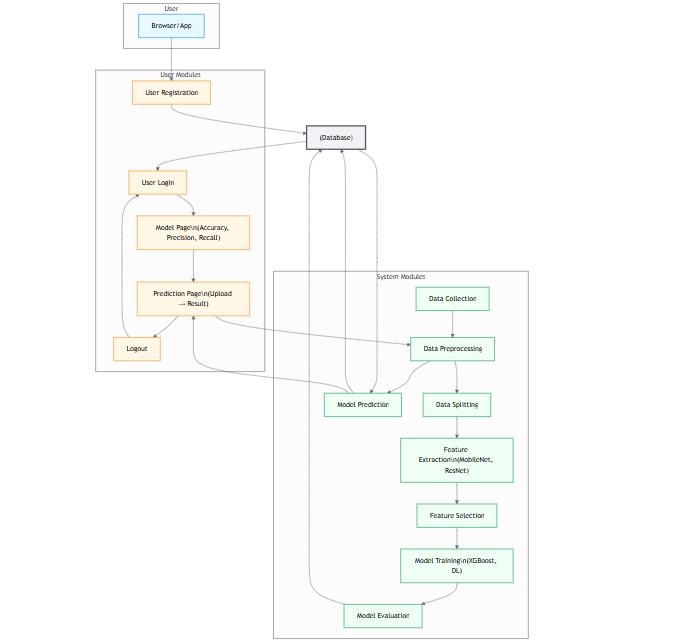
This project aims to enhance the detection and classification of plant diseases in crops such as tomatoes, potatoes, and peppers. The system uses deep learning models like MobileNet and DenseNet for efficient feature extraction, capturing critical patterns from plant images. To improve the classification accuracy, advanced feature selection techniques are employed, including mutual information, ANOVA-based methods, standardized deviation, and entropy-based criteria. These techniques help to identify the most relevant features, filtering out noise and enhancing the overall performance of the models. After feature selection, the refined features are fed into powerful classifiers—XGBoost and Random Forest (RF)—known for their accuracy and robustness in handling complex data. The system provides a web-based interface built with HTML, Flask, and JavaScript, allowing users to log in, register, and upload plant images for disease analysis. Once an image is uploaded, the system classifies the disease and provides results, assisting farmers and agricultural experts in timely diagnosis. By combining deep learning, statistical feature selection, and advanced classifiers, this system offers an effective tool for plant disease detection and management.
Keywords:
Hybrid Classification, Plant Diseases, Feature Extraction, MobileNet, DenseNet, XGBoost, Random Forest, Feature Selection, Mutual Information, ANOVA, Entropy-based Methods, Disease Classification, Agricultural Technology, Deep Learning, Image Classification, Flask, Web Application.
NOTE: Without the concern of our team, please don't submit to the college. This Abstract varies based on student requirements.
Block Diagram
Specifications
1. SOFTWARE REQUIREMENS
Operating System : Windows 7/8/10
Server-side Script : HTML, CSS, Bootstrap & JS
Programming Language : Python
Libraries : Flask, Pandas, Sklearn,Pytorch,Torchvision NumPy, Seaborn, Matplotlib,pillow
IDE/Workbench : VSCode
Technology : Python 3.8+
Server Deployment : Xampp Server
Database : MySQL
2. HARDWARE REQUIREMENTS
Processor - I5/Intel Processor
RAM - 8GB+ (min)
Hard Disk - 128 GB+
Key Board - Standard Windows Keyboard
Mouse - Two or Three Button Mouse
Monitor - Any

Demo Video


Request for Video
 Paper Publishing
Request Call Back
Would you like to receive a free callback now?
Choose the best time for callback:
Leave your message and we will contact you as soon as possible

6-2-85/B, Old Maternity Hospital Road, Thyagaraja Nagar, Tirupati, Andhra Pradesh – 517501
+91 9030333433
+91 9393939065
0877-2261612

Disclaimer - Takeoff Edu Group Projects are not associated or affiliated with IEEE in any way. The IEEE Projects mentioned here are mentioned in the context of student projects, whose ideas are derived from IEEE publications, not projects of or by IEEE.

