Enhancing Fairness and Accuracy in Diagnosing Type 2 Diabetes in Young Adult Population
Objective
The primary objective of this project is to improve the fairness and accuracy of type 2 diabetes diagnosis for young adults, a population often underrepresented in conventional predictive models. The project aims to identify and mitigate age-related bias in machine learning algorithms by developing customized models for distinct age bands. It seeks to integrate clinical, lifestyle, and demographic features to train Age-Personalized Ensemble Learning, Age-Weighted Neural Networks, and Synthetic Minority Age Sampling with Hybrid Classifiers. Ultimately, the goal is to provide reliable, age-sensitive predictions that support early intervention, informed clinical decisions, and equitable healthcare delivery for younger individuals at risk of diabetes
Abstract
Type 2 diabetes, traditionally considered a condition of older adults, is increasingly prevalent among young adults, posing a significant health risk if undiagnosed. Conventional machine learning models often exhibit biases towards majority age groups, leading to underdiagnosis in younger populations. This study introduces a novel framework to enhance fairness and accuracy in predicting type 2 diabetes among young adults. We propose three advanced algorithms: Age-Personalized Ensemble Learning (APEL), Age-Weighted Neural Network (AWNN), and Synthetic Minority Age Sampling combined with a Hybrid Classifier (SMASH). Unlike traditional models, our approach trains separate predictive models for each 5-year age band (30–34, 35–39, 40–44), ensuring age-specific learning and reducing digital ageism. Using clinical and lifestyle features—including age, gender, BMI, waist circumference, fasting glucose, HbA1c, blood pressure, cholesterol levels, activity level, smoking status, and family history—our methodology demonstrates improved diagnostic accuracy for underrepresented age groups. Experimental results highlight substantial reductions in prediction bias and enhanced model reliability across age bands. This research provides a practical and ethical approach for age-sensitive diabetes diagnosis, supporting clinicians in early detection and personalized healthcare delivery for young adults.
Keywords: Type 2 diabetes, young adults, digital ageism, machine learning bias, age-personalized models, ensemble learning, neural networks, minority sampling, hybrid classifier, healthcare analytics.
NOTE: Without the concern of our team, please don't submit to the college. This Abstract varies based on student requirements.
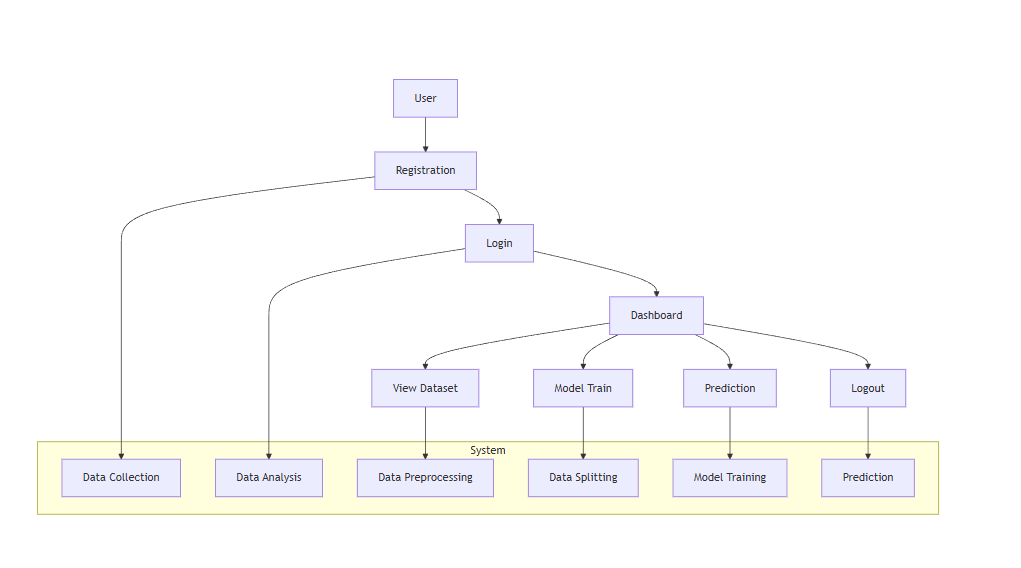
Block Diagram
Specifications
Hardware Requirements
Processor - I3/Intel Processor
Hard Disk - 160GB
Key Board - Standard Windows Keyboard
Mouse - Two or Three Button Mouse
Monitor - SVGA
RAM - 8GB
Software Requirements:
Operating System : Windows 7/8/10
Server side Script : HTML, CSS, Bootstrap & JS
Programming Language : Python
Libraries : Django, Pandas, Numpy, Tensorflow, Scikit-learn.
IDE/Workbench : VS Code
Technology : Python 3.10
Database : SQLite

Demo Video


Request for Video
 Paper Publishing
Request Call Back
Would you like to receive a free callback now?
Choose the best time for callback:
Leave your message and we will contact you as soon as possible

6-2-85/B, Old Maternity Hospital Road, Thyagaraja Nagar, Tirupati, Andhra Pradesh – 517501
+91 9030333433
+91 9393939065
0877-2261612

Disclaimer - Takeoff Edu Group Projects are not associated or affiliated with IEEE in any way. The IEEE Projects mentioned here are mentioned in the context of student projects, whose ideas are derived from IEEE publications, not projects of or by IEEE.

