Enhancing Defect Classification in Solar Panels with Electroluminescence Imaging and Advanced Machine Learning Strategies
Objective
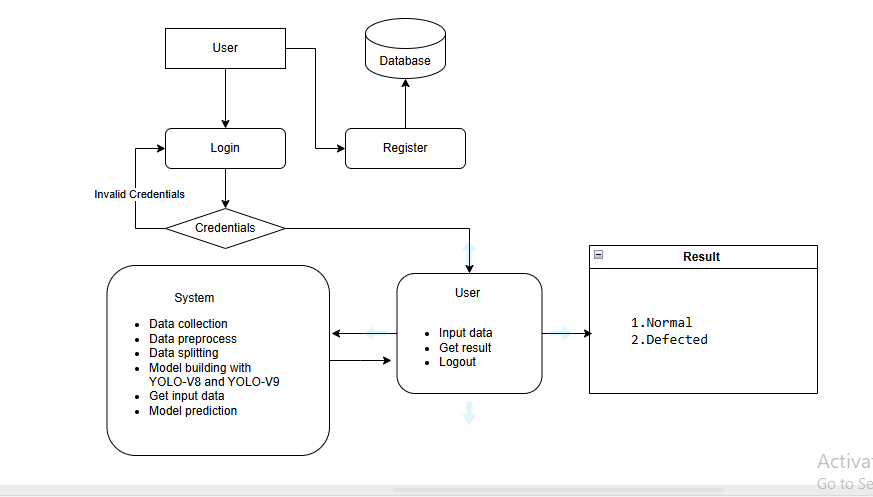
The objective of this project is to design and implement an automated system for detecting and classifying defects in solar panels using Electroluminescence (EL) imaging combined with advanced deep learning algorithms. The project aims to leverage the capabilities of YOLOv8 and YOLOv9 object detection models to accurately identify common faults such as microcracks, broken finger lines, and inactive regions in solar cells.
Abstract
Keywords: Electroluminescence Imaging, Solar Panel Defects, YOLOv8, YOLOv9, Automated Visual Inspection, Deep Learning, Microcrack Detection, Solar Cell Monitoring, Image Classification, Fault Detection.
NOTE: Without the concern of our team, please don't submit to the college. This Abstract varies based on student requirements.
Block Diagram
Specifications
HARDWARE AND SOFTWARE REQUIREMENTS
HARDWARE REQUIREMENTS:
· Processor I3/Intel Processor
· RAM 4GB (min)
· Hard Disk 160GB
SOFTWARE SYSTEM CONFIGURATION:
· Operating System : Windows 7/8/10
· Server side Script : Express js
· Programming Language : TypeScript
· IDE/Workbench : VS Code
· Database : Mongodb
· Clint Side : React js

Demo Video


Request for Video
 Paper Publishing
Request Call Back
Would you like to receive a free callback now?
Choose the best time for callback:
Leave your message and we will contact you as soon as possible

6-2-85/B, Old Maternity Hospital Road, Thyagaraja Nagar, Tirupati, Andhra Pradesh – 517501
+91 9030333433
+91 9393939065
0877-2261612

Disclaimer - Takeoff Edu Group Projects are not associated or affiliated with IEEE in any way. The IEEE Projects mentioned here are mentioned in the context of student projects, whose ideas are derived from IEEE publications, not projects of or by IEEE.

