Enhancing Cloud Security A Multi-Factor Authentication and Adaptive Cryptography Approach Using Machine Learning Techniques
Objective
The objective of this project is to create a robust security framework for cloud computing by integrating multi-factor authentication (MFA), adaptive cryptography, and machine learning. It aims to implement a multi-layer authentication system using passwords, fingerprint recognition, and conditional attributes for stronger access control. Additionally, the project focuses on enabling secure file uploads, where files are encrypted with AES and require either fingerprint authentication or OTP for decryption. The system will also introduce dynamic cryptography, adapting encryption algorithms based on predicted attack patterns.
Abstract
The rapid adoption of cloud computing has led to significant concerns regarding the security and privacy of sensitive data stored in cloud environments. Authentication plays a pivotal role in protecting user data from unauthorized access. This paper presents a robust security framework integrating multi-factor authentication (MFA) and adaptive cryptography to safeguard cloud systems against evolving cyber threats. The proposed system utilizes a combination of passwords, conditional attributes, and fingerprint authentication to verify users, while employing AES, ECC + HMAC (SHA-512), HMAC-MD5 + PBKDF2, and Blowfish + HMAC SHA3-256 encryption algorithms for secure data protection. A key feature of the system is the file upload module, where users can securely upload files encrypted with AES. To access these files, users must authenticate either through fingerprint recognition or by entering a one-time password (OTP). Additionally, a prediction tab is integrated, allowing users to input specific values to predict potential attack types. The attack prediction system, powered by a Hybrid CNN-Transformer model, classifies threats and adjusts the system’s encryption strategy dynamically to enhance security. The proposed framework demonstrates resilience against various attack vectors, including brute force, spoofing, phishing, and credential stuffing, achieving a remarkable 96.8% accuracy in attack prediction. The system’s adaptive nature allows it to continuously evolve and strengthen security based on real-time threat analysis, thereby providing a highly effective solution for enhancing cloud security.
Keywords: Multi-factor Authentication (MFA), AES Encryption, Fingerprint Authentication, One-time Password (OTP), Machine Learning Techniques, File Encryption.
NOTE: Without the concern of our team, please don't submit to the college. This Abstract varies based on student requirements.
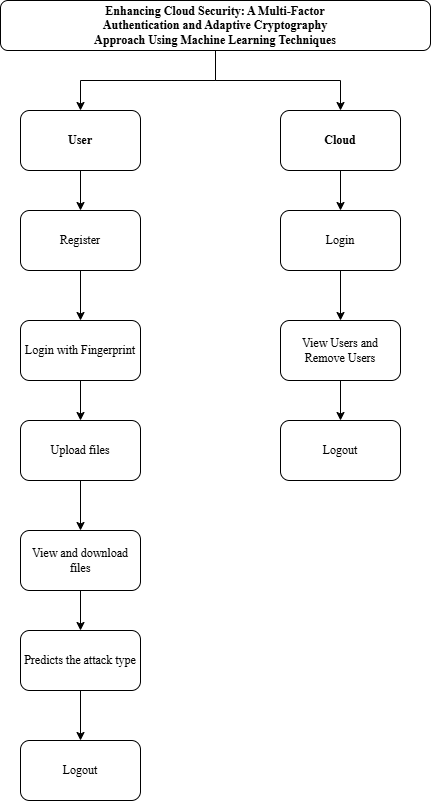
Block Diagram
Specifications
H/W CONFIGURATION:
Processor - I3/Intel Processor
Hard Disk - 160GB
Key Board - Standard Windows Keyboard
Mouse - Two or Three Button Mouse
Monitor - SVGA
RAM - 8GB
S/W CONFIGURATION:
Operating System : Windows 10
Server-side Script : Python 3.6
IDE : Pycharm, VS code
Libraries Used : Django or Flask, Numpy, IO, OS, Keras, pandas


 Paper Publishing

Request Call Back
Would you like to receive a free callback now?
Choose the best time for callback:
Leave your message and we will contact you as soon as possible

6-2-85/B, Old Maternity Hospital Road, Thyagaraja Nagar, Tirupati, Andhra Pradesh – 517501
+91 9030333433
+91 9393939065
0877-2261612

Disclaimer - Takeoff Edu Group Projects are not associated or affiliated with IEEE in any way. The IEEE Projects mentioned here are mentioned in the context of student projects, whose ideas are derived from IEEE publications, not projects of or by IEEE.

