Enhancement of Solar PV Panel Efficiency Using Double Integral Sliding Mode MPPT Control
Also Available Domains Solar Power Generation|DC - DC Converters
Objective
The main objective of this project is to enhance the efficiency of solar photovoltaic (PV) panels through the implementation of a Double Integral Sliding Mode Maximum Power Point Tracking (MPPT) control strategy.
Abstract
This paper proposes an extraction of maximum power from the solar panels, using the sliding mode control scheme, becomes popular for partial weather atmospheric conditions due to its effective dynamic duty cycle ratio. However, the sliding mode control scheme was sophisticated with single integral and double integral sliding mode control scheme, which offer enhanced maximum power extraction and support enhanced solar panel efficiency in partial weather conditions. The operation of the sliding mode control scheme depends on the selection of a sliding surface selection based on the atmospheric weather condition, which enables the effective sliding duty cycle ratio operation for the DC/DC boost converter. The duty cycle ratio of the sliding mode control resembles the usual dynamic behavior to achieve enhanced efficiency compared to the various maximum power point tracking (MPPT) schemes. The major limitation of the sliding mode control scheme is to achieve the steady state voltage error of the solar panel in minimum settling time duration. The single integral sliding mode control scheme achieves the expected steady state voltage error limit but fails to achieve minimum settling time duration. Hence, the single integral sliding mode control is extended to a double integral sliding mode control scheme to achieve both steady state voltage error limits within the minimum settling time duration. This double integral sliding mode control scheme allows us to obtain the higher sliding surface duty cycle ratio which acts as the input signal to the boost converter. This activates the enhanced stable and reliable system operation, and nullifies the lacuna of maximum solar panel efficiency under partial weather conditions. Hence, this paper aims to present the design and performance operation of the double integral sliding mode (DISM) MPPT control scheme. To validate the performance analysis of the proposed DISM MPPT control scheme, the MATLAB/Simulink model is designed and verified. Also, the performance analysis of the proposed DISM MPPT control scheme is compared with the sliding mode controller (SMC) scheme and single integral sliding mode controller (SISMC) scheme. The performance analysis of the proposed double integral sliding mode controller (DISMC) scheme attains 99.10% of efficiency and a very less settling time of 0.035 s when compared to other existing methods.
Keywords: Maximum power point tracking (MPPT) schemes, sliding mode controller (SMC), double integral sliding mode controller (DISMC), pulse width modulation (PWM), photovoltaic (PV) system.
NOTE: Without the concern of our team, please don't submit to the college. This Abstract varies based on student requirements.
Block Diagram
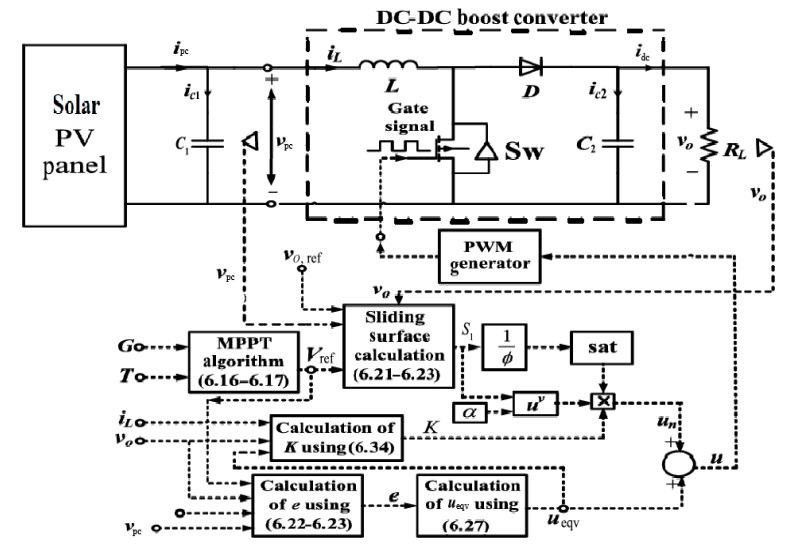
Specifications
Software Configuration:
Operating System : Windows 7/8/10
Application Software: Matlab / Simulink
Hardware Configuration:
RAM : 8 GB
Processor : I3 / I5 (Mostly prefer)
Learning Outcomes
· Introduction to Matlab/Simulink
· What is EISPACK & LINPACK
· How to start with MATLAB
· About Matlab language
· About tools & libraries
· Application of Matlab/Simulink
· About Matlab desktop
· Features of Matlab/Simulink
· Basics on Matlab/Simulink
· We can learn about PV panel
· We can learn about Boost converter
· We can learn about sliding mode control
· We can learn about double integral sliding mode control (DISMC)
· We can learn about MPPT techniques
· Introduction to converters
· We can learn about controllers
· Project Development Skills:
o Problem analyzing skills
o Problem solving skills
o Creativity and imaginary skills
o Programming skills
o Deployment
o Testing skills
o Debugging skills
o Project presentation skills
Thesis writing skillsDemo Video


Request for Video
 Paper Publishing
Request Call Back
Would you like to receive a free callback now?
Choose the best time for callback:
Leave your message and we will contact you as soon as possible

6-2-85/B, Old Maternity Hospital Road, Thyagaraja Nagar, Tirupati, Andhra Pradesh – 517501
+91 9030333433
+91 9393939065
0877-2261612

Disclaimer - Takeoff Edu Group Projects are not associated or affiliated with IEEE in any way. The IEEE Projects mentioned here are mentioned in the context of student projects, whose ideas are derived from IEEE publications, not projects of or by IEEE.

