Enhanced Predictions of Pancreatic Cancer Patient Survival in Local Hospital
Objective
The objective of this project is to advance precision medicine by developing and validating enhanced predictive models for pancreatic cancer patient survival. This involves leveraging to analyze complex clinical and biomarker data, improving the accuracy of survival predictions. The goal is to create more precise and individualized forecasts, enabling tailored treatment plans. By integrating these advanced models into a local hospital setting, the project aims to enhance patient care, support informed clinical decisions, and ultimately improve survival outcomes for pancreatic cancer patients.
Abstract
This project focuses on enhancing precision medicine for pancreatic cancer by developing predictive models for patient survival using advanced machine learning algorithms. The research analyzed a dataset from a local hospital, consisting of 14 clinical and biomarker features, including patient demographics, diagnosis details, and biomarkers like plasma CA19-9, creatinine, LYVE1, REG1B, TFF1, and REG1A. The machine learning techniques employed include Elastic Net (EN), Decision Trees (DT), Radial Basis Function Support Vector Machine (RBF-SVM), Random Forest, and a Stacking Classifier. Extensive feature engineering was performed, incorporating Box-Cox transformation and effective handling of outliers and missing values to improve model performance. The models exhibited high accuracy in predicting patient survival, with Decision Trees, Random Forest, and the Stacking Classifier achieving perfect accuracy scores of 1.00. The Elastic Net and RBF-SVM models also performed well, with accuracy scores of 0.85 and 0.80, respectively. The study highlights the potential of these machine learning models to advance precision medicine by offering more accurate predictions of pancreatic cancer patient outcomes. This can lead to more personalized treatment plans, ultimately improving patient care and survival rates. The findings underscore the importance of integrating machine learning techniques into clinical settings to enhance the predictive accuracy of survival outcomes, thereby providing valuable insights for healthcare professionals in the treatment of pancreatic cancer.
Keywords: Precision medicine, pancreatic cancer, machine learning, Elastic Net, Decision Trees, Radial Basis Function Support Vector Machine, Random Forest, Stacking Classifier, feature engineering, Box-Cox transformation, patient survival prediction.
NOTE: Without the concern of our team, please don't submit to the college. This Abstract varies based on student requirements.
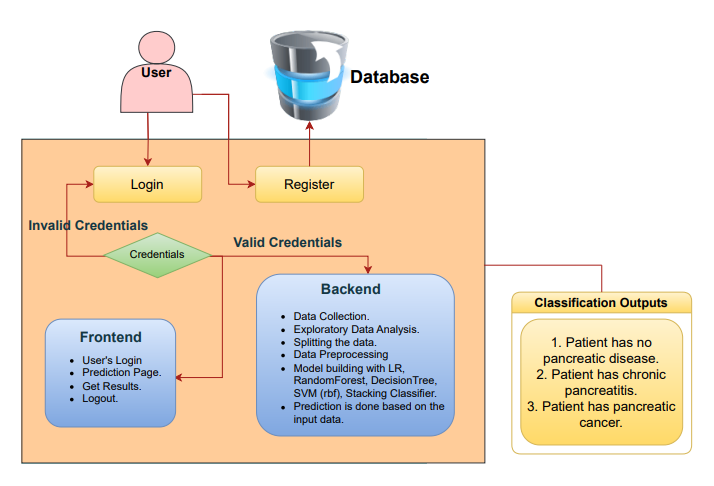
Block Diagram
Specifications
Hardware Requirements
Processor - I3/Intel Processor
Hard Disk - 160GB
Key Board - Standard Windows Keyboard
Mouse - Two or Three Button Mouse
Monitor - SVGA
RAM - 8GB
Software Requirements
• Operating System : Windows 7/8/10
• Programming Language : Python
• Libraries : Pandas, Numpy, scikit-learn.
• IDE/Workbench : Visual Studio Code.

Demo Video


Request for Video
 Paper Publishing
Request Call Back
Would you like to receive a free callback now?
Choose the best time for callback:
Leave your message and we will contact you as soon as possible

6-2-85/B, Old Maternity Hospital Road, Thyagaraja Nagar, Tirupati, Andhra Pradesh – 517501
+91 9030333433
+91 9393939065
0877-2261612

Disclaimer - Takeoff Edu Group Projects are not associated or affiliated with IEEE in any way. The IEEE Projects mentioned here are mentioned in the context of student projects, whose ideas are derived from IEEE publications, not projects of or by IEEE.

